
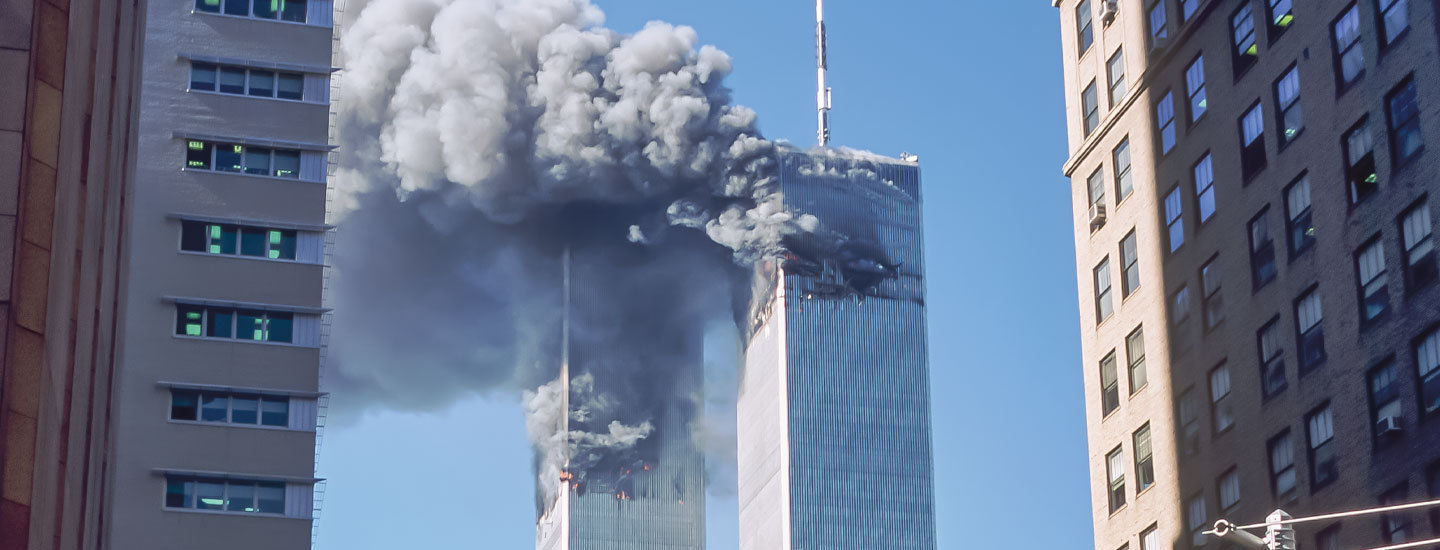

Historical photo of the Twin Towers with smoke and flames rising from both buildings on September 11, 2001

Smoke pours out of the Twin Towers in New York City on September 11, 2001.

Chris Collins/Corbis via Getty Images

STANDARDS

NCSS: Time, Continuity, and Change

Social Studies/ELA: Cite text evidence, synthesize primary sources, determine author’s purpose

Standards

U.S. HISTORY

Voices From 9/11

The United States experienced the deadliest terrorist attacks in the nation’s history on September 11, 2001. These are stories of people who survived. 

On September 11, 2001, life in the United States was brought to a standstill.

At 8:46 that morning, a passenger jet crashed into one of the Twin Towers in New York City. The silver skyscrapers were part of the World Trade Center, a huge office complex where about 50,000 people worked. The towers were a symbol of the nation’s wealth and strength.

As smoke poured out of the North Tower, witnesses thought the crash must have been an accident. But 17 minutes later, at 9:03 a.m., a second plane slammed into the South Tower. 

It was suddenly clear: The U.S. was under attack. Terrorists had seized the planes, turning them into deadly weapons. Thousands of people fled the burning towers as rescue workers raced to the scene.

Then, at 9:37 a.m., a third plane hit the Pentagon. That is the headquarters of the U.S. military in Arlington, Virginia. Shortly after, at 10:03 a.m., a plane crashed into a field near Shanksville, Pennsylvania. That aircraft may have been heading for the U.S. Capitol in Washington, D.C., where Congress meets. But passengers on that plane, who by then had learned of the other attacks, fought the terrorists on board to prevent that from happening.

There was more devastation to come. Back at the World Trade Center, the Twin Towers collapsed, with scores of people still inside.

U.S. officials determined that Al Qaeda, a terrorist group partly based in Afghanistan, was responsible. Nearly 3,000 people were killed, and millions more were affected for years to come (see “How 9/11 Changed the World” ). What was it like to experience 9/11 firsthand? Read on to learn from some of the survivors.

Into the Choking Smoke
Watch a video about September 11 from a surviving firefighter.

The First Plane Hits ■ Thomas Panevino

Courtesy Judi Panevino

Thomas Panevino, 11, walked past the Twin Towers every morning on his way to school, which was about three blocks north of the World Trade Center. The seventh-grader was in his first- period Spanish class, in a room with windows facing the North Tower.

“We were in the middle of singing songs in Spanish. . . . And we see this plane kind of just shoot across the sky. I just remember seeing like a flash of silver, and then, you know, obviously it hit the [North] Tower. [Our] whole building shook and this massive fireball just kind of rained down . . . around our school and on the streets below. . . . Everyone was just really unsure what was going on. We still were kind of under the belief that it was an accident, but something just felt wrong.”

Thomas’s father picked him up from school minutes after the first plane hit. They fled to New Jersey by boat along with thousands of other people.

Escaping the Towers ■ Keating Crown

Courtesy Keating Crown

Keating Crown worked at a finance company on the 100th floor of the South Tower. From his office, he saw the massive damage to the North Tower. Unsure what might happen next, he got into an elevator that took him down to the 78th floor, where about 200 other people had gathered. Suddenly, the second plane slammed into the South Tower. It impacted the 77th to 85th floors, directly where he was standing. The force knocked everyone to the ground.

“Stone had come off the walls, glass had obviously broken, and you couldn’t see a thing through the black smoke. . . . After crawling around for a little while, . . . I saw a crack of light around a corner and went straight for it. [It turned out to be a stairwell. I] probably got down another 20 floors or so, and I ran into three men on the stairwell, and one . . . stopped me, and was asking if I was okay. That was the first moment where I took account of what I might have looked like. I was bleeding pretty badly. [When I reached the ground floor, a paramedic treated a wound on my head.] That’s when I started to feel some of my other injuries—cuts on my back, cuts on my face, and my leg, which was clearly broken.”

Crown was driven away in an ambulance minutes before the South Tower fell. 

Molly Riley/Reuters

The Pentagon on 9/11

Pentagon Rescue ■ Marilyn Wills

Courtesy Marilyn Wills

U.S. Army Lieutenant Colonel Marilyn Wills had been running late to work that morning. She barely had time to kiss her two daughters and husband goodbye. Wills was giving a presentation at the Pentagon in Arlington when a massive fireball suddenly ripped through the conference room, throwing her across the table. A plane had just crashed directly below her second-floor meeting. The lights went out, and the room started to fill with smoke, making it hard to breathe.

“A lady behind me, who was holding on to me, she said, ‘Colonel Wills, I can’t go any further.’ And I’m like, ‘Yes, you can. . . . We gotta get out of here!’ And she says, ‘I can’t.’ I’m like, ‘OK. Just get on my back, and I’m going to carry you.’ . . . We finally got to the window, and we start banging . . . but it would not open. [A military specialist tried to break the glass with a printer.] Me and another colonel and this specialist, we just kept pounding on the window. We used our feet, and he threw the printer again and the window popped open. [We lowered everyone down. Outside,] these men had built a human ladder [to reach] that window to get us.”

Wills went on to serve in the war in Afghanistan, fighting to bring the people responsible for 9/11 to justice.

Matt Moyer/Corbis via Getty Images

Firefighters search for survivors amid the ruins of the Twin Towers.

The Towers Fall ■ Adrienne Walsh

FDNY

At 9:59 a.m., the South Tower collapsed in an enormous cloud of debris. Hundreds of terrified onlookers ran from the destruction. New York City firefighter Adrienne Walsh and her crew sped toward it, arriving at the site minutes later. Born and raised in New York City, Walsh had known since she was a teen that she wanted to be a firefighter. She was gathering gear from her fire truck when she looked up. It was 10:28 a.m., and the North Tower was collapsing.

“I saw what I can only describe as almost like a tornado hurtling at me. Just this cloud of dust that had to be over 100 feet in the air, and it was literally circling, and it was just bearing down. . . . I turned around and I yelled, ‘Run! Run, Cap! Run!’ because the captain was behind me. . . . We all took off down the block, and I thought—I honestly thought in the midst of all that . . . If I beat the cloud, I’ll beat the building. And I [thought] as I turned and started to run, I’m not gonna beat this cloud. It’s just moving too fast.”

Walsh did outrun the debris. She and her fellow firefighters spent the next several months helping with the recovery efforts at the World Trade Center site.

Surviving the Collapse ■ David Lim

PAPD

Earlier that morning, Port Authority police officer David Lim and his police dog Sirius had been inspecting the basement of the South Tower. When the North Tower was struck, the dad of two left Sirius behind so he could help evacuate the building. Lim was helping a woman named Josephine Harris down the stairs when the North Tower began to crumple around them.

“I got down to about, about the fourth or fifth floor, on the platform, and the building started to collapse. . . . I took Josephine and I put her on the ground, and I covered her up to protect her. It sounded like an onrushing locomotive or a . . . hurricane. I actually could feel the wind of the air being pushed through the building as the floors were collapsing. When the collapse stopped, I remember laying there and I remember coughing. And I also had a thought: Well, dead men don’t cough, so I must still be alive. And I was very grateful for that.”

Rescue workers pulled Lim and Harris from the rubble of the North Tower five hours after it collapsed. They were among only about two dozen survivors who had been inside the Twin Towers when the buildings fell. Sirius, Lim’s police dog, died in the South Tower. He was later buried with full police honors.

SOURCES: Scholastic Magazines+ (Thomas Panevino excerpt); NATO (Marilyn Wills excerpt); 9/11 Memorial & Museum (all other excerpts)

YOUR TURN

Analyze Primary Sources

What details from each of the eyewitness accounts stand out to you? Why? How does each person’s experience help you understand the impact that the 9/11 terrorist attacks had on them as individuals and on the country as a whole?


Interactive Quiz for this article

Click the Google Classroom button below to share the Know the News quiz with your class.

Download .PDF
videos (1)
Skills Sheets (5)
Skills Sheets (5)
Skills Sheets (5)
Skills Sheets (5)
Skills Sheets (5)
Lesson Plan (2)
Lesson Plan (2)
Text-to-Speech