
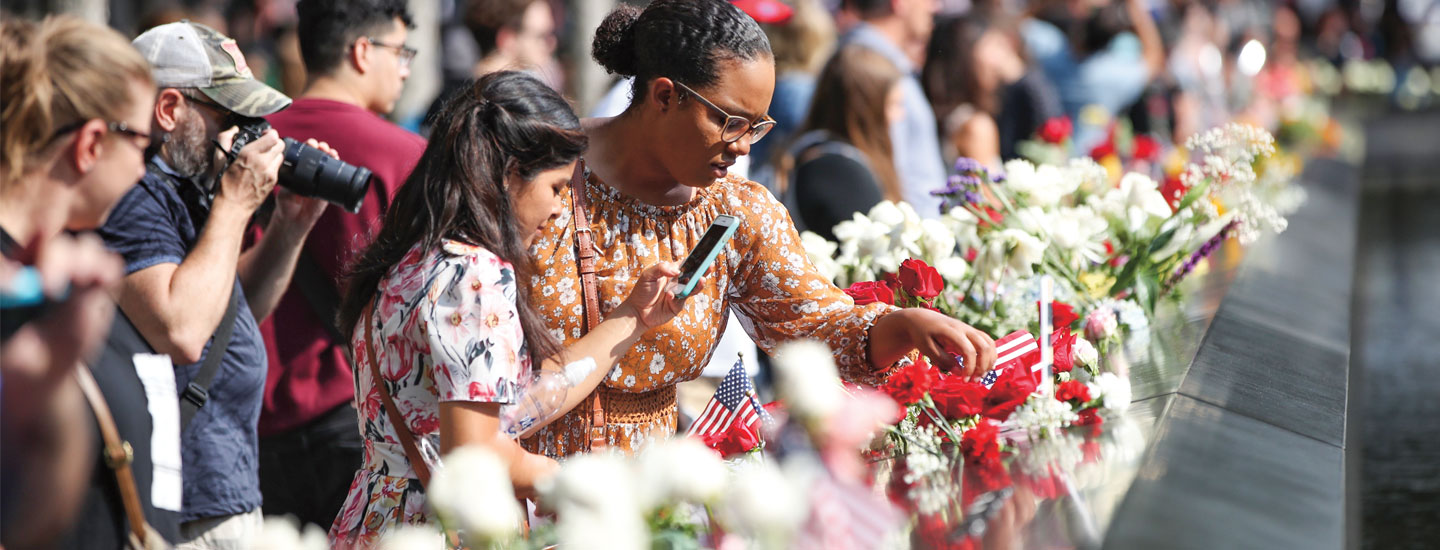

A crowd gathers at a memorial wall lined with flowers and small American flags

People place flowers at the  9/11 Memorial in New York City.

Vural Elibol/Anadolu Agency via Getty Images

STANDARDS

NCSS: Time, Continuity, and Change • Global Connections

Social Studies/ELA: Examine cause and effect, determine author’s purpose

Standards

WORLD NEWS

How 9/11 Changed the World 

The deadly attacks on the United States affected people around the globe. Here are four ways the tragedy has impacted daily life over the past 25 years.

Into the Choking Smoke
Watch a video about September 11 from a surviving firefighter.

Uniting People

              DelensMode/Getty Images

One World Trade Center (center) overlooks a 9/11 memorial pool in New York City. Opened in 2014, the tower symbolizes renewed strength.

Millions of people watched in horror as news of the attacks unfolded on live television. Their shared grief brought them together.

In the days following the tragedy, rescue workers from dozens of states and Canada traveled to the attack sites to search for survivors. Americans of all races and backgrounds stood together in long lines to donate blood for the wounded. People also filled churches, synagogues, and mosques to pray for the victims.

Other countries gave support too. Many nations offered messages of sympathy and vowed to help the U.S. fight back, recalls Jon Alterman. He is a terrorism expert at the Center for Strategic and International Studies in Washington, D.C. “There was a remarkable sense of solidarity,” he says.

Tighter Security

Hiroko Masuike/AFP via Getty Images

A police officer checks bags in  Washington, D.C.

Before 9/11, anyone could walk right up to an airplane gate. But the rules became stricter when U.S. airports reopened two days after the attacks. For one, only ticketed passengers could go beyond security checkpoints.

Two months later, Congress created the Transportation Security Administration (TSA). TSA set security standards for U.S. airports, including tighter limits on what could be brought on planes and the screening of passengers, bags, and eventually even shoes for threats.

The stepped-up security went beyond air travel. In the U.S. and parts of Europe and Asia, it’s become common to go through metal detectors to enter sports arenas or government buildings. You might also spot soldiers patrolling train stations or cameras monitoring city streets. “There’s a level of security that we take for granted now that we never had before,” Alterman says.

One 9/11-era measure ended last summer though: Airline passengers no longer have to remove their shoes for screening.

A War on Terror

Brennan Linsley/AP Images

A U.S. soldier in Afghanistan in November 2001

Days after the attacks, President George W. Bush announced a global campaign to put an end to terrorism. U.S. officials had determined that a terrorist group called Al Qaeda was responsible for 9/11.

The group’s leader, Osama bin Laden, wanted to “punish” the U.S. for influencing culture and politics in the Middle East, where Al Qaeda was partly based. The group follows an extreme form of Islam that the vast majority of Muslim people (those who practice Islam) disagree with. That religious connection led to a rise in violence against Muslim Americans in the U.S.

In October 2001, the U.S. and its allies invaded Afghanistan, where bin Laden lived while plotting the attacks. They wanted to catch him and to overthrow the Taliban. That extreme religious group controlled most of Afghanistan and had allowed Al Qaeda to operate there.

Fighting expanded to another country, Iraq, in 2003. That war lasted for more than eight years. The U.S. killed bin Laden in 2011, but the Afghanistan conflict went on for another 10 years. It was the longest war in U.S. history.

More than 7,000 American troops and an estimated 430,000 Iraqi and Afghan civilians died in the two wars. Al Qaeda was temporarily dismantled, but new terrorist groups, such as the Islamic State, emerged.

In 2021, the Taliban retook control of Afghanistan. It has since reimposed harsh rules, including restricting rights and education for women and girls.

New Laws and Agencies

Mark Wilson/Getty Images

U.S. President George W. Bush signs the Homeland Security Act in 2002. The law created the Department of Homeland Security.

Less than two months after 9/11, Bush signed the USA Patriot Act into law. It gave the government more power to monitor Americans’ phone calls and other communications. The goal was to prevent more attacks.

Then, in early 2002, Bush approved the creation of the Department of Homeland Security (right). Its role is to oversee border and transportation security, as well as immigration and emergency response efforts. Now the third-largest Cabinet department, it is largely focused on immigration.

Over the years, many Americans pushed back against the Patriot Act, saying it gave the government too much power and violated their right to privacy. In 2015, Congress replaced it with a less-invasive version. Much of that act expired in 2020, but some of the monitoring powers are still in effect.

YOUR TURN

Conduct an Interview

Find an adult who was alive in 2001 and remembers how life changed. Use information from the article to come up with five questions to ask them.


Interactive Quiz for this article

Click the Google Classroom button below to share the Know the News quiz with your class.

Download .PDF
videos (1)
Skills Sheets (6)
Skills Sheets (6)
Skills Sheets (6)
Skills Sheets (6)
Skills Sheets (6)
Skills Sheets (6)
Lesson Plan (2)
Lesson Plan (2)
Text-to-Speech