
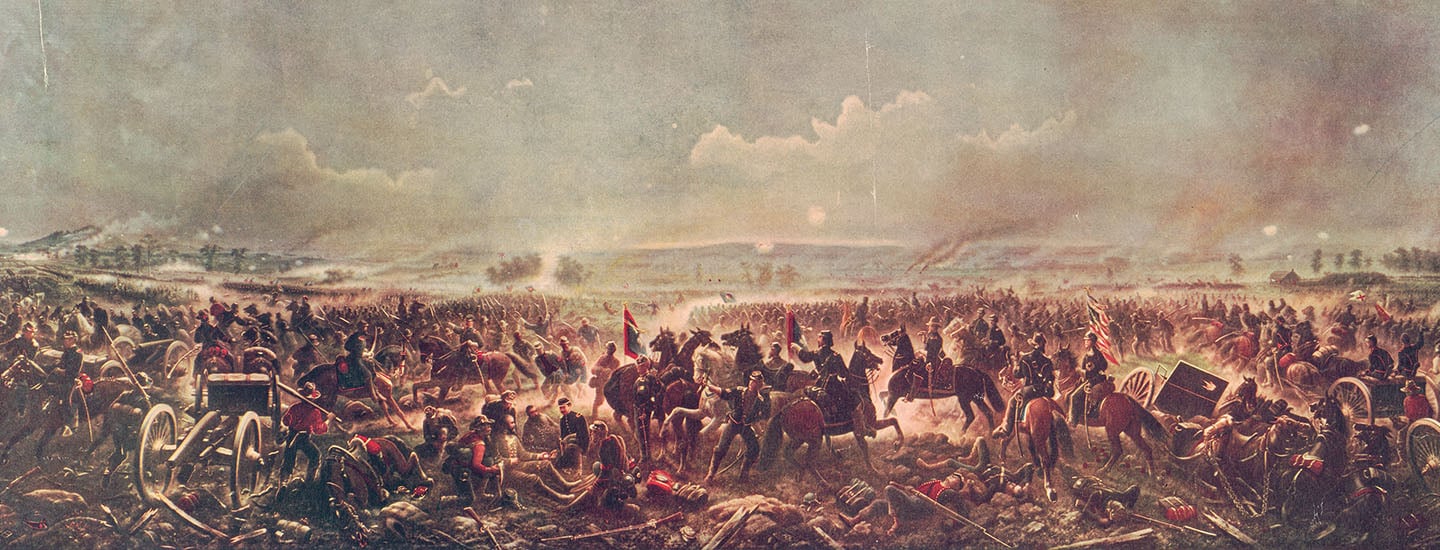

Mounted cavalry charge across a smoky battlefield past cannons, flags, & wounded men on the ground

Library of Congress

STANDARDS

NCSS: Time, Continuity, and Change • Civic Ideals and Practices

Social Studies/ELA: Determine central ideas, synthesize primary sources

Standards

U.S. HISTORY

Voices From Gettysburg

In 1863, Union and Confederate soldiers clashed in Gettysburg, Pennsylvania. The historic battle turned the tide of the Civil War in the Union’s favor. These are the stories of people who were there. 

In July 1863, the gently rolling hills of Pennsylvania became the backdrop for one of the bloodiest conflicts in American history: the Battle of Gettysburg. 

The United States was two years deep into the Civil War (1861-1865)—a conflict that would determine whether the country would forever be split in two.

Eleven Southern states had seceded from the Union starting in 1860 after Abraham Lincoln was elected president. They declared themselves the Confederate States of America. Most Northern states had already banned slavery, and the Southern states feared that Lincoln would end the practice nationwide. Many Southerners viewed slavery as essential to their rural economy, which included growing cotton and other crops. 

America's Civil War
Watch a video about the lead-up to and fighting of the U.S. Civil War (1861-1865).

The war erupted in April 1861. By July 1863, the Confederacy had already won several key conflicts, mostly in the South. Robert E. Lee, a Confederate general, was ready to defeat the Union once and for all.

Lee marched his 75,000-man army north from Virginia, aiming to seize Harrisburg, Pennsylvania’s capital. Meanwhile, Union forces in Pennsylvania had found out about Lee’s plans. Led by General George G. Meade, Union soldiers set out to stop the Confederate troops. 

As word of the fighting spread, Union and Confederate forces flooded into Gettysburg to take up arms.

A Chance Encounter 

Early in the morning on July 1, Confederate soldiers stopped in Gettysburg to load up on supplies. Suddenly, they crossed paths with Union forces. A Union soldier fired the first shot, starting the battle.

As word of the fighting spread, more Confederate and Union forces descended on Gettysburg. Armed with muskets and cannons, they clashed on foot and on horseback. 

That first day, Confederate troops—also called rebel soldiers—overwhelmed Union forces, pushing them south of town. On July 2, many Union troops regrouped on high ground. That gave them an advantage—a clearer view of the enemy’s movements and a better position to attack from. 

That day’s clashes sprang up in wheat fields, on hillsides, and even in a peach orchard. The loss of life was immense, but the Union was able to hold its positions.

On July 3, Lee took a gamble in a disastrous attack that became known as Pickett’s Charge—named for one of its commanders, General George Pickett. Lee ordered about 12,500 Confederate soldiers to charge Union troops positioned on a raised area called Cemetery Ridge. The rebel soldiers had to cross open ground to reach the ridge. Union gunfire killed or wounded nearly half of them. Approximately 30 minutes into the charge, the fighting in Gettysburg ended. The next day, the Confederate army withdrew back to Virginia.

The Cost of War

The Battle of Gettysburg was a turning point. It motivated Lincoln to push forward with the war, and it encouraged Union troops to keep fighting. It also sapped the Confederacy of its momentum. Following another two years of war, Lee surrendered his forces in April 1865. The fighting ended soon after.

But the victory in Gettysburg came at a terrible expense: In just three days, a staggering 51,000 men were killed, wounded, or missing. 

What was it like to have lived through the Battle of Gettysburg? Read on to find out from accounts of people who experienced the conflict firsthand.

A Housekeeper Running for Cover

Charlotte Carter

Before it turned into a battlefield, Gettysburg was home to about 2,400 people. Carter was one of roughly 200 Black residents in the town. Most had fled when they heard Confederate troops were coming because the Southern forces were kidnapping free Black people and forcing them into slavery. But Carter, who was about 20 years old, stayed. She was working as a housekeeper for a White woman named Mrs. Hartzell, who had two children. As the fighting broke out, Carter and Hartzell fled to a neighbor’s house.

Charlotte Carter, later in life

“I was bakin’ that day, but I left my bread in the oven, and we didn’t take nothin’ we were so [scared]. Mrs. Hartzell ran along with the little girl, and I gathered up the little three-year-old boy and hurried after her. We got to high ground and stopped to look back—and oh! There was the beautifulest sight—the Union army all in line of battle. The blue coats and guns and flags stretched away a long distance as [far] as we could see. . . . We got safely to the house of an old gentleman named Chriss. He and his family, and the rest of us went down in the cellar. . . . The children and nearly every one was cryin’. . . . Then some one come and told us we must get out of there and go across the fields to another house. That house . . . was thronged with Rebels, and they stopped me and said to Mrs. Hartzell: ‘Hey, what you doin’ with her? She’s got to go along with us.’

‘You don’t know what you’re talkin’ about,’ Mrs. Hartzell said, and I was so [scared] I hung onto her skirts. We got down in the cellar, and I crawled way back in the darkest corner and piled everything in front of me. I was the only colored* person there, and I didn’t know what might happen to me. . . . I’m sure of one thing—if they ever fight again in this country I don’t want to be around.”


*The term colored, once used to describe Black people, is now considered outdated and offensive.

Image reproduced courtesy of Northampton County Historical and Genealogical Society

Men from the Union’s 153rd Pennsylvania Infantry Regiment

A Wounded Soldier Stays in the Fight

Francis Stofflet

Stofflet was a private in the Union’s 153rd Pennsylvania Infantry Regiment. On the first day of the battle, he and his regiment fought Confederate soldiers north of Gettysburg, at a site called Barlow’s Knoll. Though Stofflet was shot several times, he kept fighting. 

“The bullets soon began to whiz. They have such a bewitching, embarrassing tone! . . . Thrice struck by bullets myself, all harmless except one which pierced my left arm at the elbow. I walked, and bled, and fought. . . . The onslaught, the beginning of the conflict was terrible. One sees pictures of battles; they give no adequate idea of the slaughter [or mass death]. The moan, the roar and the tumult are absent. You hide from one bloody scene only to be introduced to another and more horrible one.” 

VCG Wilson/Corbis via Getty Images

The Union’s 20th Maine Infantry Regiment at Little Round Top on July 2, 1863

Leading Union Men Into Battle

Joshua Chamberlain

A lieutenant colonel in the Union army, Chamberlain was the commanding officer of the 20th Maine Infantry Regiment. On July 2, the 34-year-old and his troops were positioned at Little Round Top, a hill south of Gettysburg. There, he led his men in a bloody battle against rebel soldiers. After enduring repeated Confederate attacks, Chamberlain ordered a bayonet charge. That meant soldiers would attach long blades to the end of their muskets and rush forward to attack the enemy at close range. This tactic finally pushed Confederate soldiers downhill and helped secure a Union victory at Little Round Top. Chamberlain described the battle in his official military report.

Library of Congress Prints and Photographs Division. Brady-Handy Photograph Collection

Joshua Chamberlain, early 1860s

“[The Confederate army] came within ten paces of our line. . . . From that moment began a struggle fierce and bloody beyond any that I have witnessed, and which lasted in all its fury, a full hour. . . . At times I saw around me more of the enemy than of my own men. . . . Three times our line was forced back, but only to rally and repulse the enemy. As often as the enemy’s line was broken and routed, a new line was unmasked, which advanced with fresh vigor. . . . As a last, desperate resort, I ordered a charge. The word ‘fix bayonets’ flew from man to man. The click of the steel seemed to give new zeal to all. The men dashed forward with a shout. . . . The enemy’s first line scarcely tried to run—they stood amazed, threw down their loaded arms and surrendered in whole companies.”

A Teen Aids the Wounded

Matilda “Tillie” Pierce Alleman

Tillie, 15, lived in Gettysburg and was taking shelter south of town at the farm of another family. As the battle moved south, that farm became a makeshift hospital for hundreds of wounded Union soldiers. On July 2 and 3, Tillie helped nurse some of those men back to health and comforted those she could not. She later wrote a book about her experiences in the war, which was published in 1889.

Matilda “Tillie” Pierce Alleman, as a young woman

“I made myself useful in doing whatever I could to assist the surgeons and nurses. [A soldier] beckoned me to him. He was holding a lighted candle in his hand, and was watching over a wounded soldier. . . . I then took the candle and sat down beside the wounded man. I talked to him and asked if he was injured badly. He answered: ‘Yes, pretty badly.’ I then asked him if he suffered much, to which he replied: ‘Yes, I do now, but I hope in the morning I will be better.’ . . . The poor man looked so earnestly into my face, saying: ‘Will you promise me to come back in the morning to see me?’ I replied: ‘Yes, indeed.’ . . .

The sun was high in the heavens when I awoke the next day. The first thought that came into my mind was my promise of the night before. I hastened down to the little basement room, and as I entered, the soldier lay there—dead. . . . As I stood there gazing in sadness at the prostrate form, the attendant looked up to me and asked: ‘Do you know who this is?’ I replied: ‘No sir.’ He said: ‘This is the body of General Weed; a New York man.’ . . . I could never forget that name.”

A Confederate Soldier’s Perspective

Louis Leon

While Pickett was leading his infamous charge at Cemetery Ridge, Leon also took part in a disastrous assault on July 3. Leon was a private in his early 20s with the Confederacy’s 1st North Carolina Infantry Regiment. He kept a journal during the war, including this entry about his experience on Culp’s Hill. 

Documenting the American South, UNC-Chapel Hill Library

Louis Leon, around 1913

“When under a very heavy fire, we were ordered on Culps Hill, to the support of [General Edward “Allegheny”] Johnson. Here we stayed all day—no, here, I may say, we melted away. We were on the brow of one hill, the enemy on the brow of another. We charged on them several times, but of course, running down our hill, and then to get to them was impossible, and every time we attempted it we came back leaving some of our comrades behind. . . . I know that our company went in the fight with 60 men. When we left Culps Hill there were 16 of us. . . . It was truly awful how fast, how very fast, did our poor boys fall by our sides.”

Library of Congress/Getty Images (2)

Top to bottom: Abraham Lincoln (circled) arrives in Gettysburg to give his historic address; people walk to the Gettysburg cemetery to hear the president speak.

A President Rallies the Nation

Abraham Lincoln

The Gettysburg National Cemetery was dedicated on November 19, 1863. More than 3,500 Union soldiers were laid to rest there. At the ceremony, Lincoln gave a speech that would go down in history.

The Gettysburg Address started with the words “Four score and seven years ago,” referring to the nation’s founding. Lincoln’s speech honored the fallen soldiers while reasserting the purpose of the Civil War. He framed it as a fight for freedom for all Americans, stressing the ideals of the Declaration of Independence that “all men are created equal.”

Lincoln’s words helped motivate Union troops to win the war. Days after the victory in 1865, Lincoln was assassinated. He left behind a lasting legacy. By the end of that year, the 13th Amendment to the U.S. Constitution abolished slavery nationwide. Here is an excerpt of Lincoln’s famous address.

The Gettysburg Address
Watch a video about this famous speech.

ARCHIVIO GBB/Alamy Stock Photo

Abraham Lincoln, in 1864

“The brave men, living and dead, who struggled here, have consecrated it, far above our poor power to add or detract. The world will little note, nor long remember what we say here, but it can never forget what they did here. It is for us the living, rather, to be dedicated here to the unfinished work which they who fought here have thus far so nobly advanced. It is rather for us to be here dedicated to the great task remaining before us—that from these honored dead we take increased devotion to that cause for which they gave the last full measure of devotion—that we here highly resolve that these dead shall not have died in vain—that this nation, under God, shall have a new birth of freedom—and that government of the people, by the people, for the people, shall not perish from the earth.”

SOURCES: Gettysburg History (Carter); “Tell Mother Not to Worry,” Soldier Stories From Gettysburg’s George Spangler Farm, by Ronald D. Kirkwood, Savas Beatie (Stofflet); Maine State Library, 1863-07-06 Chamberlain’s Gettysburg battle report 1863, 20th Maine Regiment 4 (Chamberlain); At Gettysburg, or, What a Girl Saw and Heard of the Battle, by Matilda “Tillie” Pierce Alleman, W. L. Borland (Pierce Alleman); Diary of a Tar Heel Confederate Soldier, by Louis Leon, Stone Publishing Company (Leon); Abraham Lincoln Presidential Library and Museum (Lincoln)

YOUR TURN

Analyze Primary Sources

Choose two of the primary sources from the article. Read each again. Then consider: How are the two accounts similar? How are they different? Together, what do they tell you about the Battle of Gettysburg?


Interactive Quiz for this article

Click the Google Classroom button below to share the Know the News quiz with your class.

Download .PDF
videos (2)
videos (2)
Skills Sheets (6)
Skills Sheets (6)
Skills Sheets (6)
Skills Sheets (6)
Skills Sheets (6)
Skills Sheets (6)
Lesson Plan (2)
Lesson Plan (2)
Article (1)
Text-to-Speech