

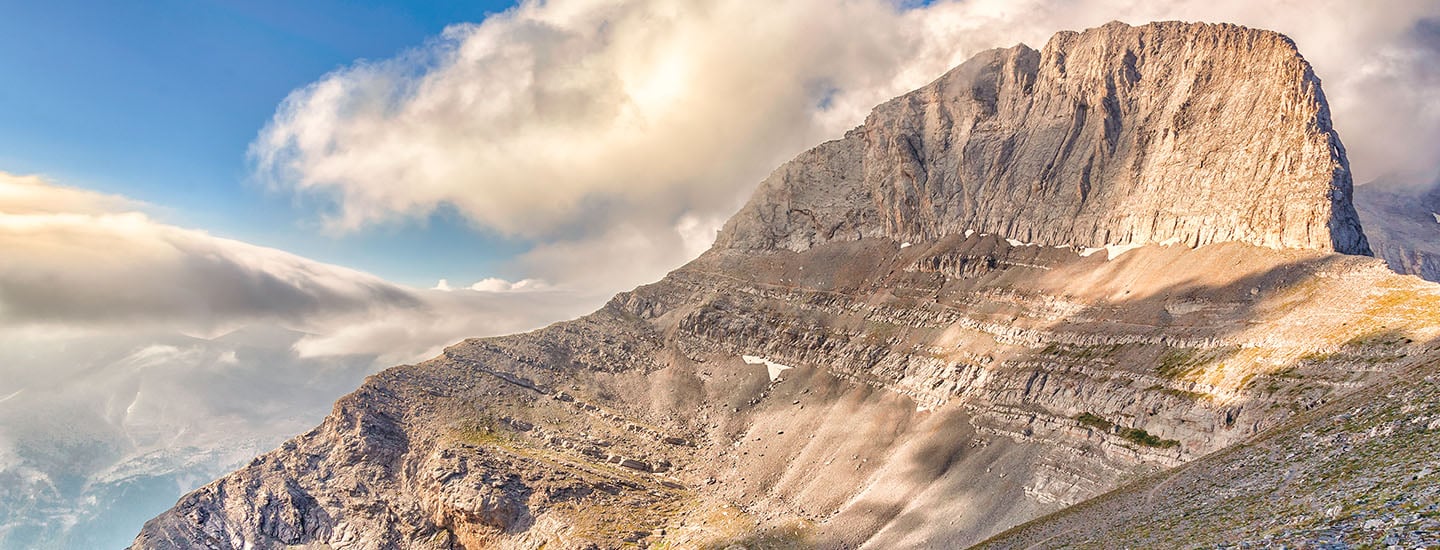

A sheer rocky summit rises above layered gray slopes with clouds banked along the ridge below

Mount Olympus in Greece is now a World Heritage Site.

Lev Paraskevopoulos/Shutterstock.com

STANDARDS

NCSS: Time, Continuity, and Change • People, Places, and Environments

Social Studies/ELA: Make inferences, conduct research

Standards

WORLD HISTORY

Crowning Mount Olympus

The mythical home of the Greek gods is a real mountain, and now it’s a protected site.

Jim McMahon/Mapman®

Zeus ruled over the sky from atop Mount Olympus, thunderbolt in hand. Poseidon controlled the seas and everything in them. Hades commanded the underworld. 

Together, they are the three most powerful gods in Greek mythology—stories that people made up thousands of years ago to help explain the world around them. But the mountain the gods called home and the land and seas they presided over were real.

Now that mountain—Mount Olympus in Greece—is getting star treatment yet again. This past July, it was named a World Heritage Site. The status, given by the United Nations Educational, Scientific, and Cultural Organization (Unesco), helps ensure that the mountain will be protected for its cultural significance. 

Olympus is an important symbol of ancient Greece. Dating back about 3,000 years, ancient Greece was the first great civilization in Europe and one of the most powerful of all time. 

“Olympus gives the modern nation of Greece a direct link to that ancient culture,” explains Christopher Baron. He teaches ancient history at the University of Notre Dame in Indiana.

Ancient Greece
Watch a video to learn more about this ancient civilization.

Day-to-Day Life

The ancient Greek civilization arose around 1000 B.C. and lasted for more than 900 years. Its people made advances in astronomy, mathematics, and medicine. They also created the world’s first democracy, with some citizens voting directly on laws.

The region was made up of more than 1,000 city-states. Each city-state had its own government and laws, but the people all shared a common language and religious beliefs. That’s where Zeus and the other gods came in.

Ancient Greeks worshipped hundreds of gods. Every deity had its own personality and powers. People thought the gods controlled all aspects of life, from health to business. They also believed that the gods got involved in the lives of people—sometimes to help and sometimes to get in the way. 

Make Zeus mad? His thunderbolt could unleash a storm that ruined your crops. Anger Poseidon? He might stir up massive waves and capsize your boat.

“The Greeks prayed to gods for protection from the weather, natural events, human enemies, but also for success,” Baron says. 

Honoring the Gods 

People built temples to please the gods and left them offerings, including food and livestock. One of Greece’s most famous temples, the Parthenon, honors Athena. She is the goddess of war and wisdom. The temple was built in the city-state of Athens—also named for Athena. Athens is now Greece’s capital.

Olympus was also a sacred spot for the ancient Greeks. It’s the tallest mountain in Greece, rising from the largest plain. The flat land around it makes the mountain’s height even more impressive, Baron says. 

Lasting Legacy

Though the Greek civilization fell to Roman conquest in 30 B.C., Olympus and its myths continue to capture imaginations today. Ancient epic poems like The Iliad and The Odyssey are still a part of culture through movies and books. 

Each year, about 10,000 hikers climb the mountain, envisioning the gods who called it home. “We find these stories about the origins of the world and the way things happen really fascinating,” notes Baron. “Olympus is an important part of that.”

YOUR TURN

Travel Back in Time

Imagine you are being transported to ancient Greece. Write five questions you’d ask about religion and daily life. Then research and write how the people might respond.

Interactive Quiz for this article

Click the Google Classroom button below to share the Know the News quiz with your class.

Download .PDF
videos (1)
Skills Sheets (6)
Skills Sheets (6)
Skills Sheets (6)
Skills Sheets (6)
Skills Sheets (6)
Skills Sheets (6)
Lesson Plan (2)
Lesson Plan (2)
Text-to-Speech