
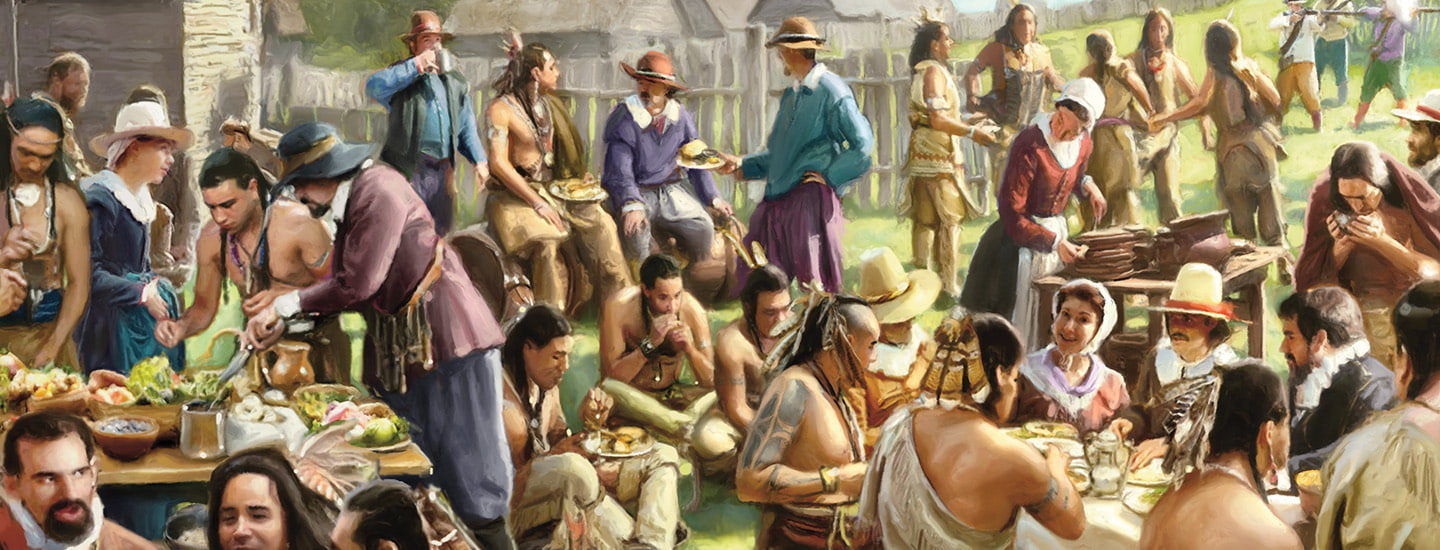

A painting shows Native Americans and colonial settlers share a large outdoor meal together

The Wampanoag and the Pilgrims feast in 1621.

Illustration by Greg Copeland

STANDARDS

NCSS: Culture • Time, Continuity, and Change

Social Studies/ELA: Identify key details, analyze a map

Standards

U.S. HISTORY

The Story Behind the First Thanksgiving

The history surrounding the famous feast is more complicated than many people realize.

Jim McMahon/Mapman®

You’ve likely heard this tale before. During the fall of 1621, a group of English settlers and Native Americans shared a feast in what is now Plymouth, Massachusetts.

The settlers, known today as the Pilgrims, had reason to celebrate. When they’d arrived from England on a ship called the Mayflower one year earlier, it hadn’t been clear whether they would even survive. But in time, Indigenous people called the Wampanoag (WAHM-puh-nahg) had helped them to grow corn, beans, and more.

Although celebrating the fall harvest was a centuries-old tradition, the meal the two groups shared eventually became known as the first Thanksgiving. It is commemorated every November in the United States.

However, the shared history between the two groups is not so simple, explains Darius Coombs. He is a Wampanoag historian. “Knowing the true story is knowing the true history of our people,” he says.

Here are three things to know about the first Thanksgiving.

1. The Pilgrims likely wouldn’t have survived without the Wampanoag.

Illustration by Greg Copeland

Tisquantum helps the Pilgrims grow crops.

When the Mayflower arrived in 1620, the Pilgrims encountered what looked like unoccupied land. The group of about 100 men, women, and children established a settlement and named it Plymouth.

However, that coastal area had once been a thriving Wampanoag village called Patuxet. Historians say it was empty only because an epidemic had wiped out the population just a few years before the Pilgrims arrived. The disease was likely brought by earlier European visitors.

A Wampanoag leader named Ousamequin (oo-SAM-uh-kwin) watched the Plymouth settlers from afar. He didn’t try to stop the Pilgrims from settling in Patuxet because the Wampanoag Nation doesn’t view land as something that can be owned.

The Pilgrims were woefully unprepared to support themselves. Over the winter, half of them died of starvation, disease, and exposure to the cold. Soon after, Ousamequin stepped in.

In the spring of 1621, he sent an English-speaking Wampanoag man named Tisquantum to help. The man, also known as Squanto, taught the settlers how to use fish to fertilize their crops. His help saved the remaining Pilgrims.

Indigenous People in North America: East
Watch a video about three Indigenous Nations.

2. The Wampanoag didn’t help the Pilgrims only out of kindness.

Ousamequin was interested in trading with the Pilgrims, and he also wanted to form an alliance with them. His nation’s longtime rivals, the Narragansett, lived nearby. And the epidemic had killed thousands of the Wampanoag’s estimated 40,000 people. Ousamequin thought getting the Pilgrims on his side could strengthen Wampanoag defenses. What’s more, the leader felt compelled to reach out to the settlers because his people were accustomed to sharing resources with each other.

Come fall 1621, the Pilgrims felt secure enough in their food supply to rejoice. But many historians point out that they didn’t initially include their Indigenous allies in the festivities. Ousamequin and nearly 100 other Wampanoag showed up unannounced, possibly looking to trade. The leader and his men were invited to stay for what became a three-day celebration.

3. The peace between the two groups was shattered within decades.  

INTERFOTO/Alamy Stock Photo

Metacom fought to protect his people.

At first, the historic gathering strengthened the relationship between the settlers and the Wampanoag. But their alliance crumbled within a generation as European settlers continued to pour into the region. By the 1670s, there were more than 50,000 colonists in New England. 

The settlers blocked the Wampanoag from the best fishing and planting areas, causing many of the nation’s people to starve. In 1675, Ousamequin’s son Metacom—also known as King Philip—led an uprising against the colonists called King Philip’s War. His forces were crushed, largely ending Native resistance to English colonization in New England.

As the U.S. grew in the centuries to come, the Wampanoag and other Indigenous groups were forced to give up much of their land and cultures. 

In New England, settlers continued to celebrate their harvests every fall. Around the 1830s, they began using the term Thanksgiving for the celebration. And the meal the Pilgrims and the Wampanoag had shared started to be called the first Thanksgiving. It was officially named a national holiday in 1863.

There are roughly 5,000 Wampanoag today, most still living in Massachusetts. For many of them, Thanksgiving is a time to mourn. But other Wampanoag, especially younger generations, use the day to honor their ancestors and their own resilience. Coombs sees that as a positive sign that his people’s culture is recovering. 

“We haven’t gone anywhere,” he says. “We’re still here.”

YOUR TURN

Write About It

What do you know now about the history of the first Thanksgiving that you didn’t know before reading this article? Write a short paragraph explaining your answer. Then share your takeaways with a classmate.

Interactive Quiz for this article

Click the Google Classroom button below to share the Know the News quiz with your class.

Download .PDF
videos (1)
Skills Sheets (6)
Skills Sheets (6)
Skills Sheets (6)
Skills Sheets (6)
Skills Sheets (6)
Skills Sheets (6)
Lesson Plan (2)
Lesson Plan (2)
Text-to-Speech