

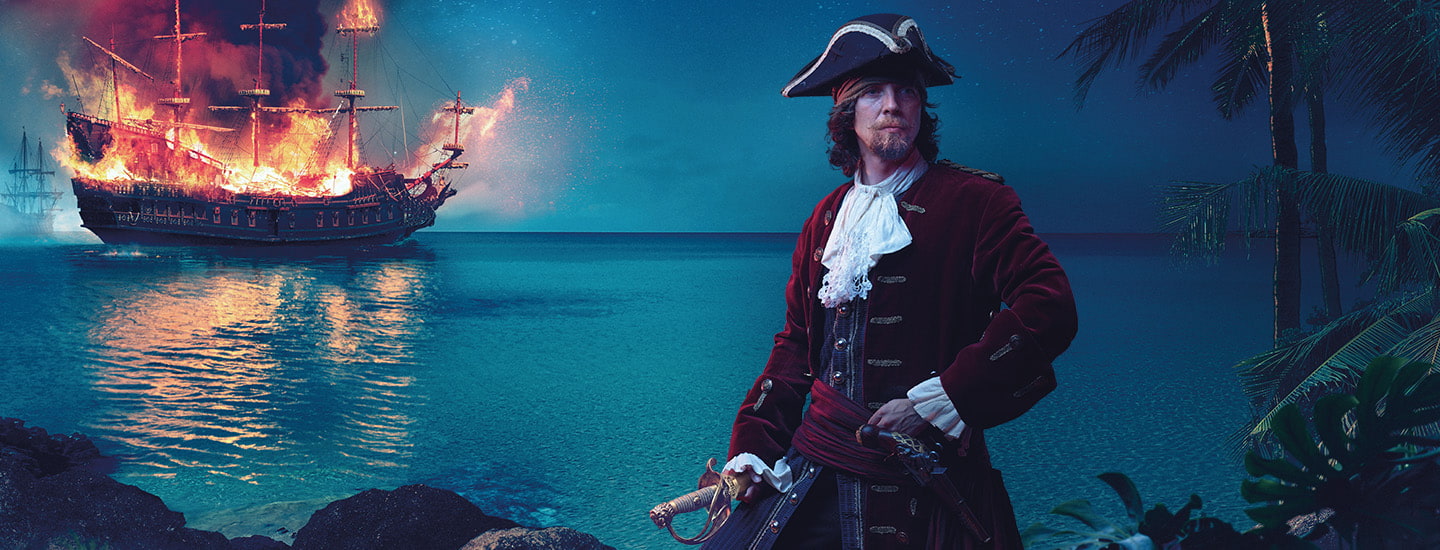

A pirate holds a sword on a shore while a tall ship burns on the water behind him

Illustration by Allan Davey

STANDARDS

NCSS: Time, Continuity, and Change • People, Places, and Environments

Social Studies/ELA: Cite text evidence, analyze maps

Standards

GEOGRAPHY

The Mystery of the Pirate King

Pirate captain Henry Avery abandoned his ship near the Bahamas more than 300 years ago to cover his crimes. Have archaeologists finally found the remains?

Jim McMahon/Mapman®

Henry Avery was one of the most daring pirates in history. Aboard his mighty ship, the Fancy, he robbed so many vessels between 1694 and 1696 that he became known as the “Pirate King.”

In his ultimate conquest, Avery and his crew raided the ship of a wealthy Asian emperor off the coast of India. The pirate made off with gold, silver, and diamonds worth nearly $150 million in today’s money.

Avery and his crew fled with their bounty to New Providence Island in the Bahamas. In the late 1600s to early 1700s, the island was a hideout for some of the most feared pirates in history (see "Pirates of the Bahamas" slideshow, below). The outlaws stayed in Nassau, the largest settlement on the island, between raids.

But this time, the authorities were hot on Avery’s trail. Determined to escape, he had someone set fire to the Fancy to destroy the evidence. Then Avery fled, leaving the ship to sink to the bottom of the sea near Nassau Harbor.

The pirate disappeared with his treasure, and the Fancy was never seen again. Until, possibly, now.

A team of divers and underwater archaeologists recently announced they have found the remains of six sunken ships in Nassau Harbor—including one that may be the Fancy. The group, called the New Providence Pirates Expedition, also found evidence of weapons that were likely used by pirates around the same period.

Prior to this breakthrough, few pirate artifacts had been located in the Bahamas, despite the area’s notorious past. The researchers hope their recent discoveries will reveal new details about the sea criminals who called New Providence Island home.

There is so much to learn, according to Michael Pateman. He is an archaeologist and the co-director of the expedition. “The pirate period is one of the least studied periods of Bahamian history,” he says.

Henry Avery was one of the most daring pirates in history. His mighty ship was called the Fancy. While aboard, he robbed many vessels between 1694 and 1696. He became known as the “Pirate King.”

His ultimate conquest? Avery and his crew raided the ship of a wealthy Asian emperor. It was off the coast of India. The pirate made off with gold, silver, and diamonds. It was worth nearly $150 million in today’s money. 

Avery and his crew fled with their bounty to New Providence Island. That is in the Bahamas. In the late 1600s to early 1700s, it was a hideout for some of the most feared pirates in history (see "Pirates of the Bahamas" slideshow, below). Between raids, the outlaws stayed in Nassau. That was the largest settlement on the island.

But this time, the authorities were hot on Avery’s trail. He was determined to escape. So he had someone set fire to the Fancy to destroy the evidence. Then he fled. He left the ship to sink to the bottom of the sea near Nassau Harbor. 

The pirate disappeared with his treasure. And the Fancy was never seen again. Until, possibly, now.

A team of divers and underwater archaeologists recently announced they have found the remains of six sunken ships in Nassau Harbor. That includes one that may be the Fancy. The group is called the New Providence Pirates Expedition. It also found evidence of weapons that were likely used by pirates around the same period.

The area had a notorious past. But few pirate artifacts had been found there until this breakthrough. The researchers hope their recent discoveries will reveal new details about the sea criminals who called New Providence Island home.

There is so much to learn, according to Michael Pateman. He is an archaeologist. He is the co-director of the expedition. “The pirate period is one of the least studied periods of Bahamian history,” he says.

Pirates: True or Untrue?
Watch a video to separate fact from fiction.

Life of a Pirate

In movies and books, pirates are often portrayed as entertaining or even charming antiheroes who bury their treasure and make their enemies walk the plank.

But in the 1600s to 1700s, real-life pirates were typically driven by desperation more than swashbuckling adventure. Many were born into poverty in Great Britain. The global superpower was involved in numerous conflicts at sea during this period, including with Spain. When the British military needed manpower, it often forced men to serve in the Royal Navy. But conditions on the military ships were terrible and the pay was low.

Some of the men—and a few women—were lured into pirate life instead. So many made the switch, in fact, that the period from approximately the 1650s to the 1730s became known as the Golden Age of Piracy.

Bands of pirates targeted thousands of merchant and military ships in waters around Europe, North America, and Africa. They attacked the vessels, stealing the goods on board and sometimes even the ships themselves. Pirates often used intimidation, rather than fighting, to pull off their crimes. But they were still known to sometimes injure or kill their enemies.

In between heists, Avery and other pirates gathered on New Providence Island. Great Britain had claimed the island around 1630 but had not established an official government there. With no rules, little authority, and a large, sheltered harbor, the island provided the perfect safe haven. From 1713 to 1718, roughly 1,000 pirates operated from there.

However, in 1718, the pirates’ reign on New Providence Island came to an end. Great Britain made the Bahamas a colony and appointed a governor to establish control. Many pirates surrendered. Others tried to flee but were eventually caught and killed, bringing the Golden Age of Piracy to a close.

In movies and books, pirates are often portrayed as entertaining or even charming antiheroes. They bury their treasure. And they make their enemies walk the plank.

But in the 1600s to 1700s, real-life pirates were not typically driven by daring adventure. They acted more out of desperation. Many were born into poverty in Great Britain. The global superpower was involved in many conflicts at sea during this period. That included conflicts with Spain. The British military needed manpower. So it often forced men to serve in the Royal Navy. But conditions on the military ships were terrible. And the pay was low.

Some of the men were lured into pirate life instead. A few women were too. In fact, so many people made the switch that there was a name for the time period. The years from about the 1650s to the 1730s became known as the Golden Age of Piracy. 

Bands of pirates targeted thousands of merchant and military ships. They were in waters around Europe, North America, and Africa. They attacked the vessels. Then they stole the goods on board. Sometimes they even stole the ships themselves. Pirates often used intimidation to pull off their crimes, rather than fighting. But they were still known to sometimes injure or kill their enemies.

In between heists, Avery and other pirates gathered on New Providence Island. Great Britain had claimed the island around 1630. But it had not established an official government there. The island had no rules, little authority, and a large, sheltered harbor. So it provided the perfect safe haven. From 1713 to 1718, roughly 1,000 pirates operated from there. 

But in 1718, the pirates’ reign on New Providence Island came to an end. Great Britain made the Bahamas a colony. A governor was appointed to establish control. Many pirates surrendered. Others tried to flee. But they were eventually caught and killed. This brought the Golden Age of Piracy to a close.

Diving Into the Search 

Much of what experts know about the history of pirates in the Bahamas comes from letters and other documents. But Pateman and the team of archaeologists were determined to find physical artifacts from the period. The group spent two years scouring historical records to identify potential areas of the seafloor to search.

The archaeologists set out last fall. They sailed east of Nassau for about 90 minutes with local guides, braving dangerous ocean currents and sharks. After diving to the seafloor, they came across a jumble of objects they soon realized was a ballast pile. That is a large collection of rocks and other heavy materials that crews centuries ago would load into lower compartments of ships to help the vessels stay balanced.

The team also spied other artifacts, including cannons and a round grinding stone for sharpening swords. They even found a swivel gun, which was typically mounted on a ship’s upper deck so pirates could fire upon enemy ships.

To Pateman, it was clear they had discovered a heavily armed sloop—a small but fast ship—dating back to the 18th century.

“It just screamed to us that this was a pirate sloop because we knew the pirates used sloops to navigate the shallow waters of the Bahamas,” he says. “It was very exciting to see something that’s quite intact.”

Much of what experts know about the history of pirates in the Bahamas comes from letters and other documents. But Pateman and the team of archaeologists were determined to find physical artifacts from the period. The group spent two years scouring historical records. They wanted to identify potential areas of the seafloor to search.

The archaeologists set out last fall. They sailed east of Nassau for about 90 minutes with local guides. They braved dangerous ocean currents and sharks. After diving to the seafloor, they came across a jumble of objects. They soon realized it was a ballast pile. That is a large collection of rocks and other heavy materials. Centuries ago, crews would load it into lower compartments of ships. It helped the vessels stay balanced.

The team also spied other artifacts. They included cannons and a round grinding stone for sharpening swords. They even found a swivel gun. It was typically mounted on a ship’s upper deck so pirates could fire upon enemy ships. 

To Pateman, it was clear they had discovered a heavily armed sloop. That is a small but fast ship. It dated back to the 18th century. 

“It just screamed to us that this was a pirate sloop because we knew the pirates used sloops to navigate the shallow waters of the Bahamas,” he says. “It was very exciting to see something that’s quite intact.”

Sean Kingsley, © Wreckwatch TV

A diver films the shipwreck that may be the Fancy.

A Historic Shipwreck?

There was an even bigger discovery yet to come. On the southern side of neighboring Paradise Island, the archaeologists came across another ballast pile. This one had a large hull, or body, of a ship sticking out of it.

Experts say the vessel may very well be Henry Avery’s, lost to the sea centuries ago. The shipwreck appears to be about the same size as the Fancy, and there is evidence that it was burned.

“We’re still collecting clues,” Pateman says, “but the wreck shows all the signs of pirate mischief. We do suspect it’s the Fancy.”

There was an even bigger discovery yet to come. This one was on the southern side of neighboring Paradise Island. The archaeologists came across another ballast pile. Sticking out of it was a large hull, or body, of a ship. 

Experts say the vessel may very well be Henry Avery’s. It was lost to the sea centuries ago. The shipwreck appears to be about the same size as the Fancy. And there is evidence that it was burned.  

“We’re still collecting clues,” Pateman says, “but the wreck shows all the signs of pirate mischief. We do suspect it’s the Fancy.”

More Treasures to Discover

While the archaeologists continue studying the shipwrecks they’ve found, they also plan to keep searching the sea for more.

The New Providence Pirates Expedition team suspects there are at least a dozen other sunken vessels to discover in and around Nassau Harbor. They plan to use underwater drones to help locate them.

“I believe we will find even more wrecks,” Pateman predicts. “The pirate history of the Bahamas is just so rich.” 

Archaeologists continue to study the shipwrecks they have found. And they plan to keep searching the sea for more.

The New Providence Pirates Expedition team suspects there are at least a dozen other sunken vessels to discover in and around Nassau Harbor. They plan to use underwater drones to help locate them.

“I believe we will find even more wrecks,” Pateman predicts. “The pirate history of the Bahamas is just so rich.”

Interactive Quiz for this article

Click the Google Classroom button below to share the Know the News quiz with your class.

Download .PDF
videos (1)
Skills Sheets (6)
Skills Sheets (6)
Skills Sheets (6)
Skills Sheets (6)
Skills Sheets (6)
Skills Sheets (6)
Lesson Plan (2)
Lesson Plan (2)
Leveled Articles (1)
Text-to-Speech