

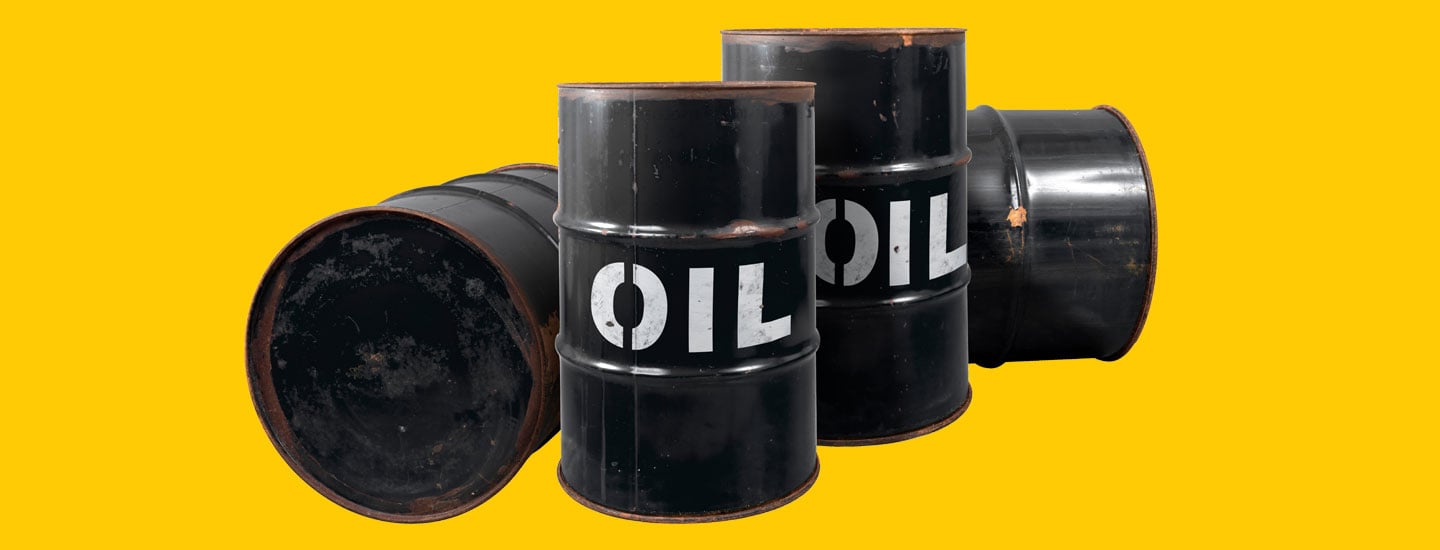

Three black metal oil barrels labeled Oil, one on its side against a yellow background

TSViPhoto/Shutterstock.com 

STANDARDS

NCSS: Production, Distribution, and Consumption • Global Connections

Social Studies/ELA: Examine cause and effect, analyze visuals

Standards

WORLD NEWS | GEOGRAPHY

The Price of Oil

Why did gas in the United States get more expensive after the war in Iran started?

This spring, the cost of gasoline in the United States jumped more than $1 a gallon and then kept going up. The reason for the spike was thousands of miles away. The war in Iran blocked a major shipping route for crude oil. That is the fossil fuel used to make gas.

The war began in February. The U.S. and Israel launched airstrikes against Iran, saying they wanted to stop it from developing nuclear weapons. In response, Iran closed the Strait of Hormuz (hawr-MOOZ). About one-third of the world’s crude oil passes through that waterway on Iran’s southern coast. The U.S., in turn, blocked ships carrying goods to and from Iranian ports.

Jim McMahon/Mapman®

The closure brought ships in the strait to a standstill. Half of the world’s top 10 oil-producing nations are in the Middle East. Their ships use the Strait of Hormuz to reach the Indian Ocean and beyond. But the narrow passage is a choke point. That means it can easily get backed up because so many ships use it.

With the strait largely closed for more than three months, the global crude oil supply dropped. That drove up the price of oil for all countries, explains Mark Finley. He is an oil expert at Rice University in Texas. “If something goes wrong anywhere, oil prices go up everywhere,” he says.

Supply and Demand

The price of crude oil isn’t decided by individual countries. The reason is that oil is a commodity, a raw ingredient used to make other products. Its price is set on a global scale, based on how much buyers are willing to pay for a 42-gallon barrel of it.

Thousands of oil purchases take place daily around the world. It’s like a giant auction that never ends, with buyers constantly placing bids for how much they are willing to pay. The highest bidders usually get the oil.

The prices are tied to supply and demand. When the crude oil supply is high and customer demand is low, the price goes down. Why? There is more oil available than people want to buy. When supply is low but demand is high, the price goes up. That’s what happened when the Strait of Hormuz closed. The amount of available oil dropped, but the number of people who needed it didn’t.

No Easy Solutions

In the U.S., rising crude oil prices don’t just affect gas prices. Higher fuel costs make it more expensive for companies to transport other products. So the price of many of those products went up this spring too.

Paying more frustrated many Americans, especially since the U.S. produces more crude oil than any other country. Alaska, Texas, and other states supply more than 13 million barrels of crude oil a day, according to the U.S. Energy Information Administration. So why didn’t those states just pump more oil?

The solution isn’t that simple, explains Hugh Daigle. He is an oil expert at the University of Texas at Austin. The makeup of crude oil is different depending on where it is from, he says. And it needs to be refined, or processed, at special factories to turn it into other products. The U.S. doesn’t have enough refineries to handle the type of crude oil pumped here.

As a result, the U.S. imports about 6 million barrels of crude oil a day. More than half comes from Canada. Less than 10 percent comes from the Middle East. But the price is still determined by supply and demand on the world scale. 

Looking Ahead

Experts say the U.S. and other nations can take steps to protect themselves against future shortages, such as by relying more on renewable energy, like wind power. Some European countries are already making that transition.

“If you don’t like paying a lot for oil, the easiest thing to do is reduce how much of it you’re using,” Daigle says.

Top Oil Producers

This list reveals how much of the world’s crude oil the top 10 countries supplied in 2025. The U.S. produced the most—more than 13 million barrels a day. 

United States: 16.1%

Russia: 11.7%

Saudi Arabia: 11.3%

Canada: 5.9%

Iraq: 5.2%

China: 5.1%

Iran: 5%

United Arab Emirates: 4.5%

Brazil: 4.5%

Kuwait: 3.1%

Note: Includes lease condensate, an ultralight oil

Top Oil Consumers

This graph shows the five nations that used the biggest share of global oil products in 2023. 

United States: 20%

China: 15.8%

India: 5.3%

Russia: 3.6%

Saudi Arabia: 3.5%

Other Countries: 51.8%

Note: Most recent data available; includes petroleum and other liquids

More Than Fuel

You may be wearing oil! The fossil fuel is used to make thousands of everyday products.

Shutterstock.com

  • Chewing gum
  • Clothes
  • Toothpaste

SOURCE: U.S. Energy Information Administration (producers, consumers, routes, choke points)

Interactive Quiz for this article

Click the Google Classroom button below to share the Know the News quiz with your class.

Download .PDF
Skills Sheets (6)
Skills Sheets (6)
Skills Sheets (6)
Skills Sheets (6)
Skills Sheets (6)
Skills Sheets (6)
Lesson Plan (2)
Lesson Plan (2)
Text-to-Speech