

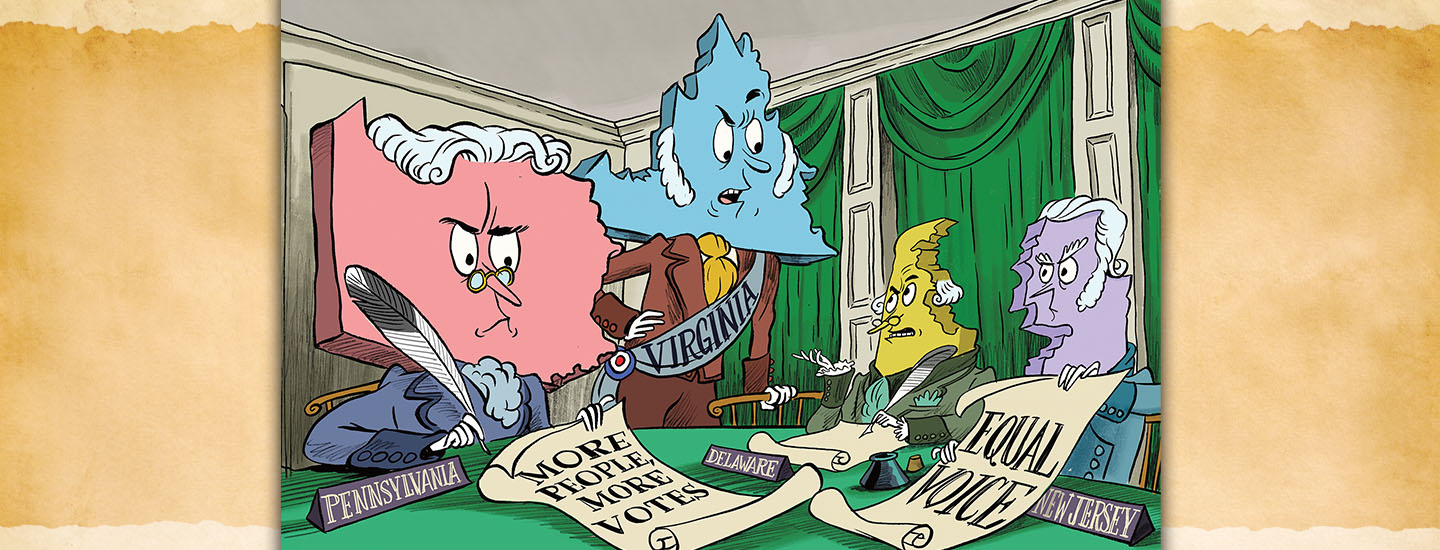

Cartoon states Pennsylvania, Virginia, Delaware, and New Jersey debate scrolls labeled More People More Votes and Equal Voice

Zohar Lazar

STANDARDS

NCSS: Time, Continuity, and Change • Power, Authority, and Governance

Social Studies/ELA: Evaluate arguments, analyze visuals

Standards

U.S. HISTORY | CIVICS

Great Debates From History: 1787

Big States vs. Small States

Explore the bitter battle over representation in Congress that almost derailed the U.S. Constitution.

It was May 1787 in Philadelphia, Pennsylvania, and dozens of men were gathered in the State House. The windows were shut to keep their discussions a secret. Sweat trickled as tempers flared.

Delegates from 12 of the 13 states (all but Rhode Island) had come together to fix the nation’s governing document, the Articles of Confederation. The Articles gave individual states nearly all the power. The federal government, meanwhile, was too weak to pass laws or collect taxes. Some people feared the nation would splinter into 13 separate countries.

It was May 1787 in Philadelphia, Pennsylvania. Dozens of men were gathered in the State House. The windows were shut to keep their discussions a secret. Sweat trickled down their faces. Tempers flared.

Delegates from 12 of the 13 states (all but Rhode Island) had come together. They wanted to fix the nation’s governing document. That was the Articles of Confederation. The Articles gave individual states nearly all the power. Meanwhile, the federal government was too weak to pass laws or collect taxes. Some people feared the nation would splinter into 13 separate countries.

The Constitution
Watch a video to learn more about this important American document.

At first, the delegates thought just updating the Articles would help. But they ended up creating a new governing document instead. Their finished product would be the U.S. Constitution. It would set up a strong federal government with three branches. A legislative branch, Congress, would make laws. An executive branch, led by the president, would implement laws. And a judicial branch, led by the Supreme Court, would settle disputes about laws.

But getting dozens of delegates to agree on that setup wasn’t easy. One of the biggest sticking points early on in the Constitutional Convention was how Americans would be represented in Congress. Delegates disagreed over how much power big states and small states should get.

Read arguments on both sides of the debate. Then turn the page to find out what happened.

Note: The quotes in this article are from James Madison’s Notes of Debates in the Federal Convention of 1787.

At first, the delegates thought just updating the Articles would help. But they ended up creating a new governing document instead. Their finished product would be the U.S. Constitution. It would set up a strong federal government with three branches. A legislative branch, Congress, would make laws. An executive branch would be led by the president. That branch would implement laws. And a judicial branch would be led by the Supreme Court. That branch would settle disputes about laws.

But getting dozens of delegates to agree on that setup was not easy. One of the biggest sticking points early on in the Constitutional Convention was how Americans would be represented in Congress. Delegates disagreed over how much power big states and small states should get.

Read arguments on both sides of the debate. Then turn the page to find out what happened.

Note: The quotes in this article are from James Madison’s Notes of Debates in the Federal Convention of 1787.

The Virginia Plan

Zohar Lazar

Edmund J. Randolph led the charge for the big states, unveiling a proposal on May 29 called the Virginia Plan. Randolph hailed from Virginia, the most populous state in the Union. One of his fellow Virginia delegates, James Madison, had drafted the proposal. 

The Virginia Plan called for Congress to be made up of two chambers, or houses. In both, voting power would be tied directly to population size. States with a lot of residents would have more representatives than states with fewer residents.

That setup would give immense power to just a few states. In 1787, the nation’s population was about 3 million. Only three states—Virginia, Massachusetts, and Pennsylvania—had more than 400,000 people each. The other 10 states were considerably smaller, with populations ranging from about 280,000 in Maryland down to about 30,000 in Georgia.

Edmund J. Randolph led the charge for the big states. He unveiled a proposal on May 29 called the Virginia Plan. Randolph was from Virginia. That was the most populous state in the Union. James Madison was one of his fellow Virginia delegates. Madison had drafted the proposal.

The Virginia Plan called for Congress to be made up of two chambers, or houses. In both, voting power would be tied directly to population size. States with a lot of residents would have more representatives than states with fewer residents.

That setup would give great power to just a few states. In 1787, the nation’s population was about 3 million. Only three states had more than 400,000 people each. Those were Virginia, Massachusetts, and Pennsylvania. The other 10 states were considerably smaller. They had populations ranging from about 280,000 in Maryland down to about 30,000 in Georgia.

Representation in Congress should be based on a state’s population.

Delegates from the other large states supported Randolph’s plan, speaking up as the weeks passed. James Wilson of Pennsylvania emphasized that representation based on population was necessary for Congress to truly represent the American people, rather than just the states. “Different numbers of people [should have] different numbers of representatives,” he argued.

Some delegates also worried that if every state had the same voting power, small states could team up and outvote the big states. That would let a minority of the country’s population decide the laws for everyone, they warned.

Delegates from the other large states supported Randolph’s plan. They spoke up as the weeks passed. James Wilson of Pennsylvania emphasized that representation based on population was necessary for Congress to truly represent the American people, rather than just the states. “Different numbers of people [should have] different numbers of representatives,” he argued.

Some delegates also worried it would be bad if every state had the same voting power. The small states could team up and outvote the big states. That would let a minority of the country’s population decide the laws for everyone, they warned.

The New Jersey Plan

Zohar Lazar

The less populous states were not thrilled with the Virginia Plan. So on June 15, a delegate from New Jersey named William Paterson offered an alternate plan. He had been one of the more outspoken delegates against the lopsided power the Virginia Plan would give the three most-populous states.

Paterson’s New Jersey Plan called for Congress to be made up of a single chamber, and for every state to have equal power in it, regardless of population. That meant each state would get one vote.

Paterson pointed out that the government was already operating this way under the Articles of Confederation and had also done so during the American Revolution (1776-1783). All 13 states had entered the Union as equals, he said, so why should that change now?

The less populous states were not thrilled with the Virginia Plan. So on June 15, William Paterson offered an alternate plan. He was a delegate from New Jersey. He had been one of the more outspoken delegates against the Virginia Plan. He did not like the lopsided power that it would give the three most-populous states.

Paterson’s New Jersey Plan called for Congress to be made up of a single chamber. He called for every state to have equal power in it, regardless of population. That meant each state would get one vote.

Paterson pointed out that the government was already operating this way under the Articles of Confederation. And it had also done so during the American Revolution (1776-1783). All 13 states had entered the Union as equals, he said. So why should that change now?

Every state deserves an equal vote, regardless of size.

Another New Jersey delegate, David Brearley, agreed with Paterson. He worried that the Virginia Plan would leave people in the smallest states with almost no voice in Congress. “Virginia would have [up to] 16 votes, and Georgia but 1,” he argued.

Brearley and other delegates from small states had done the math. They knew that Virginia alone had nearly 100,000 more people than Delaware, Georgia, New Hampshire, New Jersey, and Rhode Island combined. So even if small states were to band together to vote in unison, the larger states could still outvote them. “The large states . . . will carry everything,” Brearley predicted.

David Brearley agreed with Paterson. He was another New Jersey delegate. He worried that the Virginia Plan would leave people in the smallest states with almost no voice in Congress. “Virginia would have [up to] 16 votes, and Georgia but 1,” he argued.

Brearley and other delegates from small states had done the math. They knew that Virginia alone had nearly 100,000 more people than Delaware, Georgia, New Hampshire, New Jersey, and Rhode Island combined. So it wouldn’t matter if the small states were to band together to vote in unison. The larger states could still outvote them. “The large states . . . will carry everything,” Brearley predicted.

The Connecticut Compromise

Zohar Lazar

The delegates spent a few days comparing the two plans. Two things became clear: Neither plan was going to be approved as is, and neither side was willing to give up on their ideas.

On June 19, the delegates voted to reject the New Jersey Plan. They decided to reshape the Virginia Plan into something a majority of them could agree on. But that proved easier said than done.

By early July, tempers in the State House were as hot as the now-sweltering weather outside. Delegates on each side remained convinced that the other side’s vision was deeply unjust. Even worse, some delegates were ready to give up on the convention entirely and head home.

The delegates spent a few days comparing the two plans. Two things became clear: Neither plan was going to be approved as is. And neither side was willing to give up on their ideas.

On June 19, the delegates voted to reject the New Jersey Plan. They decided to reshape the Virginia Plan into something a majority of them could agree on. But that proved easier said than done.

By early July, tempers in the State House were as hot as the summer weather outside. Delegates on each side were still convinced that the other side’s vision was deeply unjust. Even worse? Some delegates were ready to give up on the convention entirely and head home.

One chamber of Congress should be equal for all states. The other chamber should be based on population.

That’s when two delegates from Connecticut—Roger Sherman and Oliver Ellsworth—came up with a new idea. Known as the Connecticut Compromise or Great Compromise, it found a way to give both sides the representation they wanted. Congress would be made up of two chambers, like the Virginia Plan had called for. The makeup of the first chamber, the House of Representatives, would be based on state population. Representation in the second chamber, the Senate, would be equal for every state.

On July 16, after two weeks of further debate and hammering out details beyond the legislative branch, the delegates voted again. The Connecticut Compromise passed by just one vote.

Over the next two months, the delegates worked out the rest of the government setup. And, after being approved by voters in nine states, the Constitution officially became the law of the land on March 4, 1789—for all states, big and small.

That is when two delegates from Connecticut came up with a new idea. They were Roger Sherman and Oliver Ellsworth. Their plan was known as the Connecticut Compromise or Great Compromise. It found a way to give both sides the representation they wanted. Congress would be made up of two chambers, like the Virginia Plan had called for. The first chamber would be the House of Representatives. Its makeup would be based on state population. The second chamber would be the Senate. Representation there would be equal for every state.

There were two more weeks of debate and hammering out details beyond the legislative branch. Then on July 16, the delegates voted again. The Connecticut Compromise passed by just one vote.

Over the next two months, the delegates worked out the rest of the government setup. The Constitution was approved by voters in nine states. And it officially became the law of the land on March 4, 1789—for all states, big and small.

Representation in Congress

The Connecticut Compromise is the reason every state has two members in the U.S. Senate, while membership in the U.S. House of Representatives is based on population. Here’s how representation in the first session of Congress, in 1789, compares with how it is today.

Senate

Then: 26 senators (two per state)

Now: 100 senators (two per state)

Then: 26 senators (two per state)

Now: 100 senators (two per state)

House of Representatives

Then: 65 representatives 
Most: 10, Virginia 
Least: 1 each, Delaware, Rhode Island

Now: 435 representatives
Most: 52, California 
Least: 1 each, Alaska, Delaware, North Dakota, South Dakota, Vermont, Wyoming

Then: 65 representatives 
Most: 10, Virginia 
Least: 1 each, Delaware, Rhode Island

Now: 435 representatives
Most: 52, California 
Least: 1 each, Alaska, Delaware, North Dakota, South Dakota, Vermont, Wyoming

YOUR TURN

Think Like a Delegate

If you had been a delegate at the Constitutional Convention in 1787, would you have supported the Virginia Plan, the New Jersey Plan, or neither? Why? How would you have voted on the Connecticut Compromise?

If you had been a delegate at the Constitutional Convention in 1787, would you have supported the Virginia Plan, the New Jersey Plan, or neither? Why? How would you have voted on the Connecticut Compromise?

Interactive Quiz for this article

Click the Google Classroom button below to share the Know the News quiz with your class.

Download .PDF
videos (1)
Skills Sheets (6)
Skills Sheets (6)
Skills Sheets (6)
Skills Sheets (6)
Skills Sheets (6)
Skills Sheets (6)
Lesson Plan (2)
Lesson Plan (2)
Leveled Articles (1)
Text-to-Speech