
Question: What did Frieda Justen face during World War II? How did the experience shape her life?
NCSS: Time, Continuity, and Change • Individual Development and Identity
Common Core: R.1, R.7, R.9, W.2
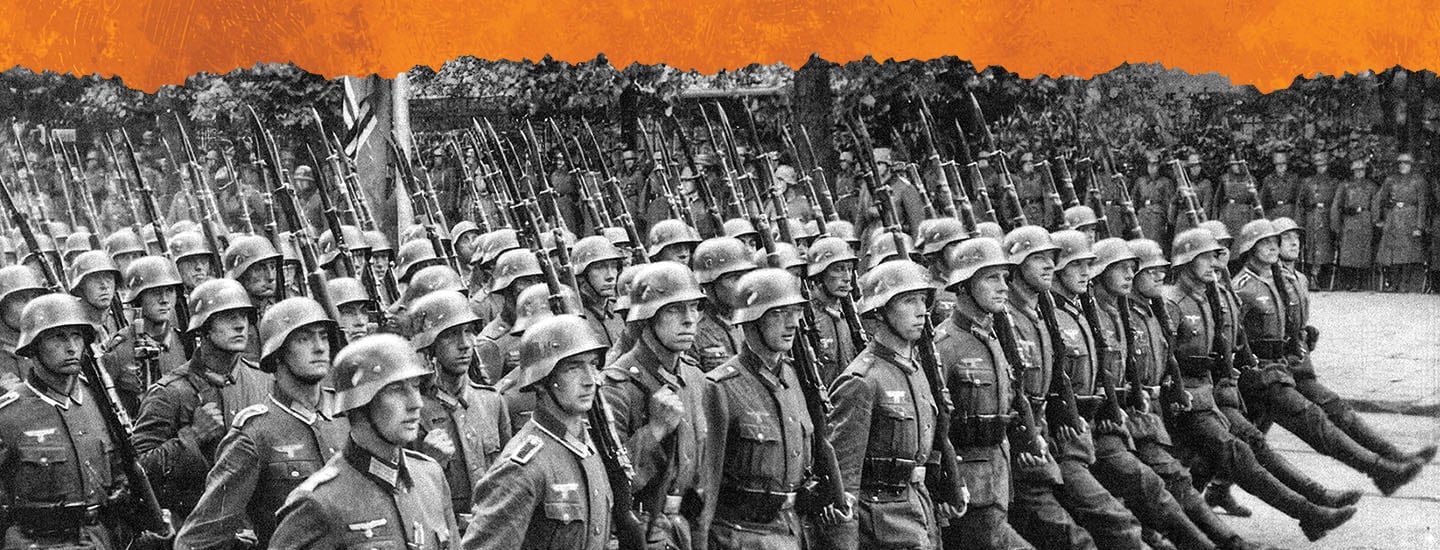
Nazi soldiers march through Warsaw, Poland, in September 1939.
Niday Picture Library/Alamy Stock Photo
STANDARDS
NCSS: Time, Continuity, and Change • Individual Development and Identity
Common Core: R.1, R.7, R.9, W.2

WORLD HISTORY
Eyewitness to History Contest Winner
When the War Came
Sabrina Sherman won our Eyewitness to History contest with her interview of a Polish woman who survived World War II.
Question: What did Frieda Justen face during World War II? How did the experience shape her life?
Courtesy of the Sherman family
Sabrina Sherman (above) interviewed Frieda Justen about her childhood.
Growing up as a child in Poland, Frieda Justen experienced the unimaginable. In September 1939, her country was invaded—twice. First, Germany attacked on September 1, starting World War II (1939-1945). Then, 16 days later, the Soviet Union invaded. The nations divided up Poland with deadly force, killing at least tens of thousands of Polish people in the process.
German dictator Adolf Hitler and his Nazi Party were determined to conquer Europe and eliminate its Jewish population. At the time, Poland was home to about 3.3 million Jewish people, including Frieda, then 11. The Nazis forced many of them into overcrowded areas called ghettos, with little food. They also built concentration camps, where they murdered or worked to death millions of Jewish people and others from across Europe.
SuperStock/Alamy Stock Photo
Nazi troops search Polish residents in September 1939.
Soviet dictator Joseph Stalin, meanwhile, wanted to expand his empire. His troops targeted any Polish people they thought might resist Soviet control. That included Jewish and non-Jewish people alike. From 1939 to 1941, Soviet troops killed tens of thousands of Polish residents, by some estimates. And they sent as many as 1 million Polish people to forced labor camps in Siberia—a vast, bitter-cold region of the Soviet Union. Frieda ended up there, struggling to survive.
Although Germany and the Soviet Union cooperated early in the war, they soon became enemies. In June 1941, Germany invaded the Soviet Union and Soviet-controlled Poland. The Soviet Union responded by joining the Allied powers, led by the United Kingdom—and later, the United States. The Allied powers were fighting Germany and the other Axis powers, Italy and Japan.
In 1945, the Allied powers defeated Germany, ending the war in Europe. But the loss of life was catastrophic. The Nazis had murdered more than 6 million Jewish people—two-thirds of Europe’s Jewish population—in what has become known as the Holocaust. More than half of them were from Poland. The Nazis and Soviets also killed about 3 million other Polish people during the war.
Frieda survived, but she lost loved ones and the home she grew up in. What was that experience like? Turn the page to read Frieda’s story in her own words.
—Lisa M. Herrington
Courtesy of the Sherman family
Sabrina Sherman, 11, of Coral Springs, Florida, with Frieda Justen
Eyewitness to History Contest Winner
A Story of Survival
I interviewed Frieda Justen, a Holocaust survivor from Poland. Now 97, Frieda was 11 years old when World War II started. This is her story.
by Sabrina Sherman
Courtesy of Frieda Justen and family
Frieda and her younger brother pose at her dance recital before the war.
Describe your childhood.
My childhood ended in September 1939 when the war broke out. Before then, I played outside with other kids. I did well at school, and I loved reading. I went to the movies.
When did you start to feel the effects of Adolf Hitler’s power?
The Germans entered Poland on September 1, but they didn’t enter my town, Jaroslaw, until about a week later. We heard talk about how the Germans would line up Jewish men and women and shoot them. My parents decided that my father and uncle would leave. They went east toward the Soviet Union. My father and uncle told us if anything happened, we should go to my grandparents. They lived in Gródek,* a town closer to the Soviet border.
How did life change in Jaroslaw with the Nazis in control?
Jews got shot everywhere—at the grocery store, on the streets—so nowhere was safe for us. My mom was scared enough to not let me or my younger brother out of the house.
What happened next?
One day, three soldiers barged into our apartment asking if we were Jewish. They gave us a couple of minutes to pack our belongings. My mother made backpacks out of bedsheets. She put one on my back and carried the other. Although the backpack was way too heavy for me, I was old enough not to cry or complain.
We went to city hall, where there were already hundreds of Jews. The Nazis lined everyone up and made them give up their most valuable items. I don’t remember what my mother gave, but I do remember that she asked a soldier if she could change my clothes in the bathroom. She took off my shoes and socks and put money under the sole of my foot. She put back on my socks and shoes, and we went back out. I heard screams and got very scared. My foot started shaking out of nervousness, and it got so bad that my mother had to put her foot over mine to stop it from shaking.
Laski Diffusion/Getty Images
Women sit in a barrack at a Soviet labor camp in 1945.
The Nazis took us to cross the San River and let us go on the Soviet side—except there was nowhere to go. My mother and aunt found a village with someone who knew my grandfather. We stayed the night and then went to my grandparents’ home in Gródek. We lived there for about a year and reunited with my father and uncle.
Then my family was forced out of Poland by the Soviets and taken to Siberia on a train without any seats. We were put in a labor camp. There was so much death around us from hunger, cold, and disease.
Describe a moment that still stands out to you to this day.
In the barrack, I made a friend, a girl around my age. She became so skinny that her arms were like little sticks and so weak that she couldn’t talk. She passed away in Siberia.
Who helped you the most during the war?
My parents. Sometimes we would only have little pieces of bread, and my mother would cut them in half for my younger brother and me. My parents would go hungry for days just so we could eat.
Did your family survive?
I was so lucky that my brother, mother, and father all survived the war. All my friends and other family passed away, including my mother’s five sisters and their families.
Sovfoto/UIG/Bridgeman Images
The Soviets forced Polish people into labor camps like this one during World War II.
What happened after the war?
We came back to Poland. There was nothing left that reflected my life. We ended up at a displaced persons camp in what is now Austria. I met and married my husband there. His parents and four younger siblings had all been killed. He and I traveled by foot and wagon to Italy, then to what is now Israel by ship. In 1954, we moved to the United States, where we raised our family. To this day, I’ve never forgotten my roots.
What I Learned
As a Jewish person, I found it hard to think about how my own ancestors were treated. I feel more connected to them now. It’s important to talk about the Holocaust so history doesn’t repeat itself.
Eyewitness to History Contest Runners-Up
Congratulations to Markian Adamiv of Parma Heights, Ohio, and Nancy Johnson of Elka Park, New York.