

Question: How can speech and debate skills help with real-life conversations?
NCSS: Civic Ideals and Practices
Common Core: R.7
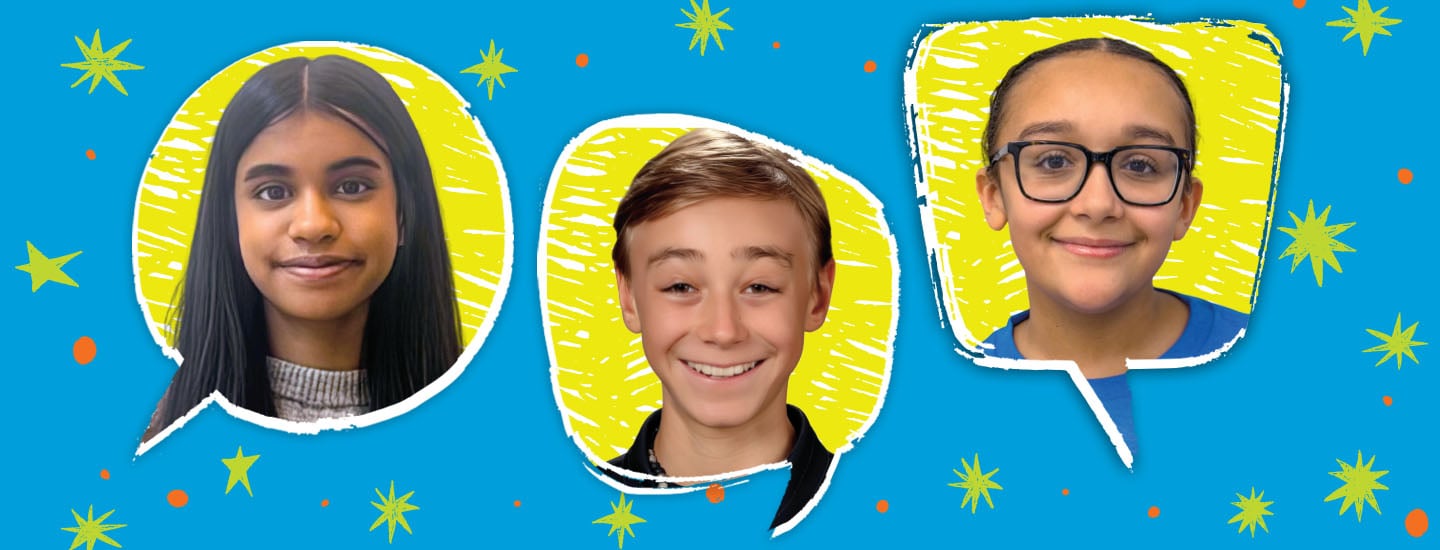
From left to right: Courtesy of Meera Natarajan (Samika Sadasivan); Courtesy of family (Connor Rozgo); Courtesy of MS 50 (Annalia Torres); Shutterstock.com (background)
STANDARDS
NCSS: Civic Ideals and Practices
Common Core: R.7

CIVICS
Speak Up!
Americans are avoiding hard conversations with people they disagree with. How can we start talking again? Three middle school debaters share their secrets.
Question: How can speech and debate skills help with real-life conversations?
In some ways, it’s never been easier to talk about politics. Opinions are everywhere: in group chats, on social media, and at the dinner table.
In fact, Americans discuss politics more today than they did 25 years ago, according to research from the University of Pennsylvania. However, those conversations are mostly between people who share the same political views, according to Diana Mutz. She is the political scientist who did the study. Conversations between people who disagree remain much less frequent. And Americans’ tolerance for people with different political views has decreased, her research showed.
As a result, experts say, we’re talking more but not necessarily listening more. And when people hear fewer opposing viewpoints, they can become less open-minded, Mutz’s study concluded.
That’s especially true if people mostly just hear their opinions being confirmed by others who agree with them. “We’re even more sure of our own views and intolerant of others’ views,” Mutz told reporters.
9%
Share of U.S. adults who report having political discussions in person very often with people who hold different political views
SOURCE: YouGov
The good news? You don’t have to be old enough to vote to start changing this trend. Across the country, students are getting skilled in something many adults struggle to do: disagreeing respectfully.
At school speech and debate clubs and programs, middle schoolers are practicing public speaking, building arguments, and discussing important issues. And they are learning how to truly listen, even when they disagree with someone.
Treating people with respect is key, says Heather Huffman. She is the head of speech and debate at the Village School in Houston, Texas, one of the top middle school speech and debate programs in the country. Conversations often unravel when emotions take over, she explains. But speech and debate clubs teach students to speak with intention and listen carefully when tensions rise.
Those skills make students better communicators—and, as a result, better citizens, Huffman says. In a democracy, people need to be able to discuss issues facing the country to figure out ways to address them.
Talking civilly can help, Huffman says. “If we are ever going to move beyond the kind of divisive, my-team-against-yours politics that we have in the world, then we’ve got to figure out how to listen to other points of view.”
How exactly do we do that? Read on for advice from three students whose experience behind the debate podium has helped them craft winning strategies for tough real-life conversations.
Courtesy Meera Nataraja
Samika Sadasivan
Pair passion with facts.
Samika Sadasivan, 14
Houston, Texas
A powerful speech doesn’t just make people feel something, Samika Sadasivan says. It also gives them reasons to believe in what you’re arguing.
The eighth-grader has been taking part in speech and debate at her school for about three years. One of her favorite events is original oratory, where students write and deliver a speech on a topic they feel strongly about. Through oratory, Samika has learned that the strongest arguments combine two things that might seem contradictory: passion and logic. Passion is an emotion that comes from your heart. Logic is straightforward reasoning based on facts.
“At first I thought that speech was mainly about being really passionate [and] appealing to emotions a lot,” she says. “But I realized that you need to express your passion the right way.” That means strong arguments should always be grounded in reason and fact, the teen explains. It’s important to care deeply about what you’re saying, but emotion alone isn’t enough to sway people. Samika backs up her passion with evidence to build more convincing cases in her debates.
She’s seen this strategy work for other students too. At one speech and debate competition, a student from another school took the stage and openly stated his political affiliation—which was different from hers. Samika’s first instinct was to assume she would disagree with everything he said. But she found herself swayed by several of his points.
Powerful things can happen when you achieve the right balance of emotion and fact, Samika says. Before she started speech and debate, she often found herself afraid to speak up. Now she has the confidence to command a room. “Once you learn to stand your ground, nothing can stop you from there,” she says.
Courtesy of family
Connor Oswego
Keep your cool.
Connor Rozgo, 13
Lake Oswego, Oregon
Seventh-grader Connor Rozgo knows what it feels like when emotions boil to the surface during an argument. He takes part in speech and debate through a class at his school. A situation can escalate quickly if two people have strong opposing opinions, he says. “It can get pretty heated.” And when emotions rise, people are less likely to be convinced. That’s why Connor’s advice is to speak calmly yet confidently.
That might sound easier said than done, but the teen has a trick he uses if his adrenaline starts to rise. Instead of continuing to look at the person he is debating, he chooses a spot in the room— like a crack in the wall or a lamp on a desk. Then he stares at it for a few seconds until he is able to regain his composure. “I try to ground myself,” he says. “I take some deep breaths and focus on what I’m trying to say.”
Another way Connor keeps his cool is by concentrating just on his current claim. There’s always going to be another side that’s arguing against you, he explains. “Focus on what you’re saying instead of what they’re going to say next.”
Staying calm has an added bonus, Connor points out. It helps you keep your tone and language respectful. People will be more likely to consider your perspective if you do that. “If people give me advice but they’re disrespectful about it, I don’t take it into consideration at all,” he says.
80%
Share of U.S. adults who think Democrat voters and Republican voters can’t agree on plans, policies, or basic facts when it comes to important issues
SOURCE: Pew Research Center
52%
Share of U.S. adults who worry that the views they express will be negatively misinterpreted
SOURCE: YouGov
© Bob Englehart, Cagle Cartoons via CartoonStock.com
One Cartoonist’s Take: A silo is a tower used to store grain. But the term can also refer to an isolated group of people. What point might the cartoonist be making about people in political parties today?
Courtesy of MS 50
Annalia Torres
Get your facts right.
Annalia Torres, 13
Brooklyn, New York
When Annalia Torres takes the debate stage, she appears cool and confident. Her secret weapon? A lot of preparation. She’s learned that habit at her school, which includes debate lessons in every grade.
Annalia has been doing speech and debate for about five years. Before a debate begins, she researches the topic to make sure she fully understands it. She considers both sides and then finds evidence to support her argument. “Doing research ahead really helps,” the eighth-grader explains. “It’s important because it makes me feel like I know what I’m talking about, instead of just debating on a random topic.”
Annalia is careful to seek out evidence that is trustworthy (see sidebar, below). That means using information from sources that are known for accuracy, not for promoting rumors or presenting opinions as fact. When a claim is based on credible information, she explains, it’s more convincing to debate judges and listeners alike. “That’s what makes a really strong argument,” the teen says.
Once she has her evidence, Annalia makes sure she knows the information inside and out so she can recall it when the pressure is on. That way she doesn’t end up struggling to remember facts in the heat of the moment.
Citing reliable evidence can also help when discussing challenging topics in everyday life, Annalia says. Being prepared and knowledgeable about a topic helps people take you seriously. “On social media, you’re able to say whatever you want,” she points out. “But that’s not going to help you get anywhere.”
How to Find Evidence You Can Trust
Research the topic. Use reliable sources, such as online encyclopedias or government websites. (Look for URLs ending in .gov.) A librarian can also help you find trustworthy sources. Read about the topic to get a general understanding, then start zeroing in on details for your evidence.
Compare sources. Don’t stop at just one source, especially if you’re getting information from news reports. Media outlets may present topics from different angles, so seek out a range. Evaluate whether claims are backed up with valid reasons and facts. And consider whether the people quoted are experts.
Double-check. Still not sure about something? Verify details with an impartial fact-checking organization, such as FactCheck.org, PolitiFact.com, or @MediaWise on TikTok or Instagram.
YOUR TURN
Share Your Wisdom
What tools or strategies have helped you talk about politics or other topics with people who think differently than you? What strategies haven’t worked? Why? Share and compare your tips with a classmate.
Interactive Quiz for this article
Click the Google Classroom button below to share the Know the News quiz with your class.
Download .PDF