

Question: What rights does the Fourth Amendment protect? How should it apply to phones?
Question: What rights does the Fourth Amendment protect? How should it apply to phones?
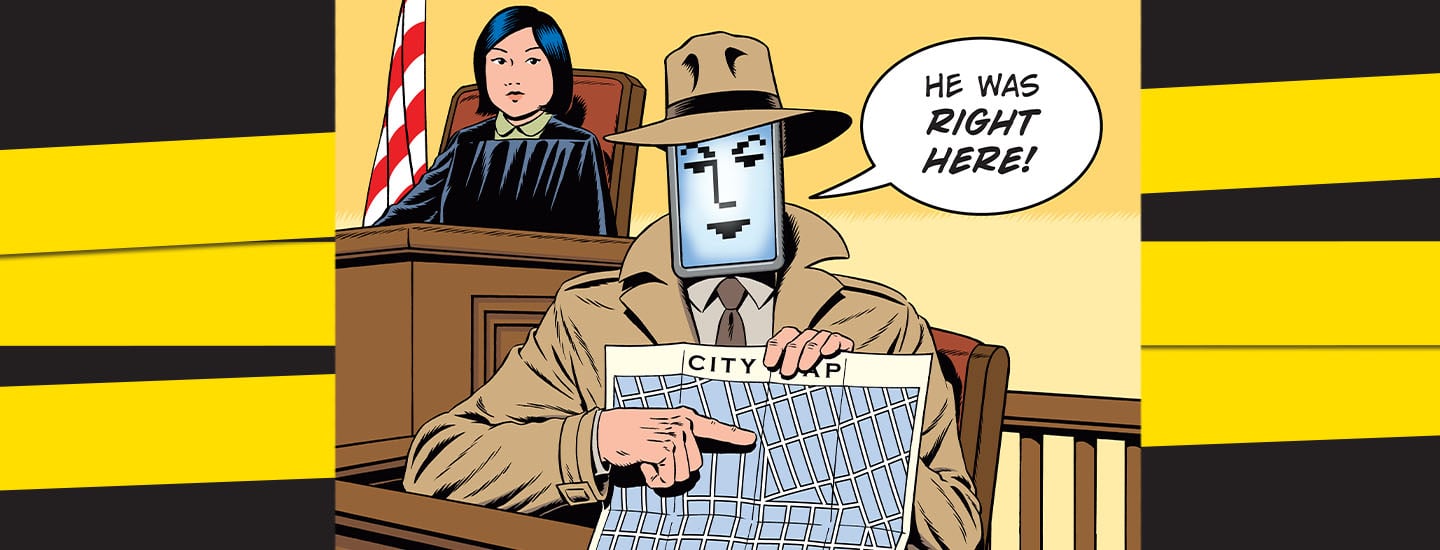
Illustration by Steve Vance
STANDARDS
NCSS: Power, Authority, and Governance • Science, Technology, and Society
Common Core: R.8

U.S. NEWS
Civics
Should Your Phone Help Solve Crimes?
Our phones collect data about us that police can use to solve crimes and convict people in court. The U.S. Supreme Court will decide whether that violates our right to privacy.
Question: What rights does the Fourth Amendment protect? How should it apply to phones?
Question: What rights does the Fourth Amendment protect? How should it apply to phones?
An armed robber was on the loose. In May 2019, someone walked into a credit union near Richmond, Virginia, holding a gun and demanding cash. A few minutes later, the robber escaped with nearly $200,000.
Police detectives searched for evidence to catch the criminal. They dusted for fingerprints and interviewed witnesses. But there wasn’t much to go on, because the suspect had been wearing a disguise. So the detectives turned to electronic evidence instead—cell phone data.
You may not give it much thought, but your cell phone is likely tracking everything you do, from the calls you make to what you buy online. Many apps, such as Google, even keep tabs on your exact location. And those companies often store—and own—the data they collect.
An armed robber was on the loose. It was May 2019. Someone walked into a credit union near Richmond, Virginia. The person was holding a gun and demanded cash. A few minutes later, the robber escaped with nearly $200,000.
Police detectives searched for evidence to catch the criminal. They dusted for fingerprints. They interviewed witnesses. But there wasn’t much to go on. The suspect had been wearing a disguise. So the detectives turned to electronic evidence instead—cell phone data.
You may not give it much thought. But your cell phone is likely tracking everything you do. It might be tracking your calls, your purchases, and more. Many apps even keep tabs on your exact location. That includes Google. Those companies often store—and own—the data they collect.
5
Minimum number of nine Supreme Court justices needed for a majority ruling
SOURCE: constitutioncenter.org
80
Estimated number of cases the Supreme Court hears each year
SOURCE: supremecourt.gov
The detectives investigating the robbery got permission from a judge to access that data. They ordered Google to identify every cell phone near the crime scene at the time of the robbery. That information led them to a man named Okello Chatrie.
Police charged Chatrie with the robbery using information from his phone. He eventually pleaded guilty and is serving a nearly 12-year prison sentence for the crime.
But the case isn’t over yet. Chatrie has appealed his conviction to the U.S. Supreme Court. He argues that the police violated his right to privacy by accessing his phone’s data without his permission. The Fourth Amendment to the U.S. Constitution protects against “unreasonable searches and seizures.”
The detectives investigating the robbery got permission from a judge to access that data. They ordered Google to identify every cell phone near the crime scene at the time of the robbery. That information led them to a man named Okello Chatrie.
Police charged Chatrie with the robbery using information from his phone. He eventually pleaded guilty. He is serving a nearly 12-year prison sentence for the crime.
But the case isn’t over yet. Chatrie has appealed his conviction to the U.S. Supreme Court. He argues that the police violated his right to privacy. He says they accessed his phone’s data without his permission. The Fourth Amendment to the U.S. Constitution protects against “unreasonable searches and seizures.”
“This case is going to determine how much privacy we have.”
—Ric Simmons, law professor
Lawyers for the federal government argue that police did nothing wrong. They say that when people share their phone data with companies, that information is no longer private.
This summer, the Supreme Court will decide whether Chatrie’s Fourth Amendment rights were violated. “Anyone with a phone—which is pretty much everyone—should pay attention,” says Ric Simmons. He is a law professor and Fourth Amendment expert at Ohio State University. “This case is going to determine how much privacy we have . . . and how far the government can go in getting information about where we are.”
Lawyers for the federal government argue that police did nothing wrong. They say that when people share their phone data with companies, that information is no longer private.
This summer, the Supreme Court will decide whether Chatrie’s Fourth Amendment rights were violated. “Anyone with a phone—which is pretty much everyone—should pay attention,” says Ric Simmons. He is a law professor and Fourth Amendment expert at Ohio State University. “This case is going to determine how much privacy we have . . . and how far the government can go in getting information about where we are.”
How Searches Work
Our nation’s founders wrote the Fourth Amendment in the late 1700s—long before cell phones existed. They were thinking about British officers. Before and during the American Revolution (1775-1783), officers would search colonists’ homes and seize their belongings without permission.
Today searches are usually done by police, but they have to follow specific rules set up to protect people’s rights. If law enforcement officers ask to search your property—whether it’s your house or your car—the Fourth Amendment gives you the right to say no. If you do agree to a search, you’re effectively giving up your Fourth Amendment protections.
If you refuse, police will need a warrant to continue. A warrant is a court document that gives law enforcement the right to perform a search. To get one, police must convince a judge that there’s “probable cause”—a reason to suspect you have broken a law.
As technology has evolved, so have warrants. The type of warrant used in the Chatrie case is called a geofence warrant. It lets police get cell phone location data for a specific time and place.
Our nation’s founders wrote the Fourth Amendment in the late 1700s. That was long before cell phones existed. They were thinking about British officers. Before and during the American Revolution (1775-1783), officers would search colonists’ homes. And they would seize their belongings without permission.
Today searches are usually done by police. But they have to follow specific rules set up to protect people’s rights. Law enforcement officers could ask to search your property, like your house or your car. But the Fourth Amendment gives you the right to say no. If you agree to the search, you’re effectively giving up your Fourth Amendment protections.
If you refuse, police will need a warrant to continue. A warrant is a court document. It gives law enforcement the right to perform a search. To get one, police must convince a judge that there’s “probable cause.” That means there’s a reason to suspect you have broken a law.
Technology has evolved. And so have warrants. The type of warrant used in the Chatrie case is called a geofence warrant. It lets police get cell phone location data for a specific time and place.
Privacy vs. Tech
Shutterstock.com
How geofence warrants work: Police essentially draw a circle around a crime scene, then get a list of every phone in that circle.
Across the United States, police seek thousands of geofence warrants a year. In the Chatrie case, the warrant covered a nearly 500-foot radius around the robbery site within one hour of the crime. Google provided a list of 19 phones that met those requirements. Each device was identified by a number so as not to reveal the owners’ identities.
Police then requested more data from Google but without any new warrants. They asked for more details about 9 of the original 19 phones for a two-hour period. Then detectives requested the names of the owners for three of those devices. One of them was Chatrie’s.
Chatrie’s lawyers say law enforcement officers did not have evidence to justify tracking the movements of every Google user near the crime. They argue that the police were allowed to search first and find evidence later—the opposite of how warrants are supposed to work. What’s more, the lawyers contend that police needed a new warrant each time they requested information from Google—not just the first time.
Meanwhile, privacy experts point out that the police tracked the movements of innocent people, some of whom were in nearby homes, a hotel, and a restaurant.
Lawyers for the government, however, argue that geofence warrants are an important part of police work, helping officers solve crimes and keep people safe. Police often use the warrants when they know when and where a crime took place but have no leads on who might have done it.
In addition, federal lawyers say the phone location data the police received wasn’t private. Google has a tracking feature that users can opt in to, allowing the company to trace their whereabouts. Chatrie had opted in. The government’s lawyers say he gave up his right to privacy when he turned on the tracking feature.
Across the United States, police seek thousands of geofence warrants a year. In the Chatrie case, the warrant covered a nearly 500-foot radius around the robbery site within one hour of the crime. Google provided a list of 19 phones that met those requirements. Each device was identified by a number. That was done so it wouldn’t reveal the owners’ identities.
Police then requested more data from Google. But they didn’t have any new warrants. They asked for more details about 9 of the original 19 phones for a two-hour period. Then detectives requested the names of the owners for three of those devices. One of them was Chatrie’s.
Chatrie’s lawyers say law enforcement officers did not have evidence to justify tracking the movements of every Google user near the crime. They argue that the police were allowed to search first and find evidence later. That is the opposite of how warrants are supposed to work. The lawyers also argue that police needed a new warrant each time they requested information from Google—not just the first time.
Meanwhile, privacy experts point out that the police tracked the movements of innocent people. Some of them were in nearby homes, a hotel, and a restaurant.
But lawyers for the government argue that geofence warrants are an important part of police work. They help officers solve crimes and keep people safe. Police often use the warrants when they have no leads on who committed a crime. They only know when and where it took place.
In addition, federal lawyers say the phone location data the police received wasn’t private. Google has a tracking feature. Users can opt into it. It allows the company to trace their whereabouts. Chatrie had opted in. The government’s lawyers say he gave up his right to privacy when he turned on the tracking feature.
Meet the Justices
Nine justices sit on the Supreme Court. They can serve for life and have the final say on whether laws are constitutional.
Evelyn Hockstein/Reuters (Barrett, Jackson, Kagan, Kavanaugh, Roberts); J. Scott Applewhite/AP Images (Alito, Gorsuch); ZUMA Press, Inc./Alamy Stock Photo (Sotomayor, Thomas)
Chief Justice John G. Roberts Jr.
Seated in 2005
Clarence Thomas
Seated in 1991
Samuel A. Alito Jr.
Seated in 2006
Sonia Sotomayor
Seated in 2009
Elena Kagan
Seated in 2010
Neil M. Gorsuch
Seated in 2017
Brett M. Kavanaugh
Seated in 2018
Amy Coney Barrett
Seated in 2020
Ketanji Brown Jackson
Seated in 2022
Chief Justice John G. Roberts Jr.
Seated in 2005
Clarence Thomas
Seated in 1991
Samuel A. Alito Jr.
Seated in 2006
Sonia Sotomayor
Seated in 2009
Elena Kagan
Seated in 2010
Neil M. Gorsuch
Seated in 2017
Brett M. Kavanaugh
Seated in 2018
Amy Coney Barrett
Seated in 2020
Ketanji Brown Jackson
Seated in 2022
What Comes Next?
How the Supreme Court will rule in this case is anyone’s guess. In recent years, lower courts have disagreed on whether geofence warrants violate people’s right to privacy.
The justices may use this decision to clarify how privacy rights apply to electronic devices, says Brent Skorup. He is a constitutional law expert at a research group called the Cato Institute. “Do we own our digital records that contain our sensitive information?” Skorup asks. “The law is uncertain about this.”
How the Supreme Court will rule in this case is anyone’s guess. In recent years, lower courts have disagreed on whether geofence warrants violate people’s right to privacy.
The justices may use this decision to clarify how privacy rights apply to electronic devices, says Brent Skorup. He is a constitutional law expert at a research group called the Cato Institute. “Do we own our digital records that contain our sensitive information?” Skorup asks. “The law is uncertain about this.”
Google, for its part, announced in 2023 that it would stop storing users’ location data so that police could no longer serve the company with geofence warrants. But other companies, including Apple and Uber, have continued to receive geofence warrants.
Regardless of how the Supreme Court rules, experts say this case is a reminder that we need to be mindful of how we use our phones.
“Your cell phone is going to track you. That’s how phones work,” Simmons says. “So all of us need to be . . . a bit more careful.”
—with additional reporting by Lauren Vespoli
Google, for one, announced in 2023 that it would stop storing users’ location data. So the police can no longer serve the company with geofence warrants. But other companies have continued to receive geofence warrants. That includes Apple and Uber.
No matter how the Supreme Court rules, experts say there is a lesson from this case. We need to be mindful of how we use our phones.
“Your cell phone is going to track you. That’s how phones work,” Simmons says. “So all of us need to be . . . a bit more careful.”
—with additional reporting by Lauren Vespoli
Interpreting the Bill of Rights
Our nation’s founders added the first 10 amendments to the U.S. Constitution in 1791 to protect key freedoms. Here’s how the meaning of three of those amendments has evolved over time.
First Amendment
This guarantees freedom of speech, religion, and the press. It also protects the right to protest and to petition the government.
THEN: Before the American Revolution, colonists under British rule could be beaten and arrested for criticizing the government. The founders wanted to prevent that injustice and give people a voice in the government.
This guarantees freedom of speech, religion, and the press. It also protects the right to protest and to petition the government.
THEN: Before the American Revolution, colonists under British rule could be beaten and arrested for criticizing the government. The founders wanted to prevent that injustice and give people a voice in the government.
LeoPatrizi/Getty Images
NOW: The Supreme Court has widened First Amendment protections to include speech on television and the internet. Certain forms of expression, like burning the American flag, are also protected. But some types of speech, like threatening to seriously harm another person, are illegal.
NOW: The Supreme Court has widened First Amendment protections to include speech on television and the internet. Certain forms of expression, like burning the American flag, are also protected. But some types of speech, like threatening to seriously harm another person, are illegal.
Second Amendment
This protects the right to bear arms, or own guns. It says people can form militias, or citizen armies, if needed.
THEN: Local militias were crucial in helping to win independence from the British. The founders wanted to make sure American citizens could take up arms if they needed to defend themselves or the country.
This protects the right to bear arms, or own guns. It says people can form militias, or citizen armies, if needed.
THEN: Local militias were crucial in helping to win independence from the British. The founders wanted to make sure American citizens could take up arms if they needed to defend themselves or the country.
Karl Weatherly/Getty Images
NOW: What this means today is hotly debated. Some say it lets people own guns. Others argue limits are needed to prevent violence. The justices have rejected some laws limiting gun rights. But they also ruled that ownership can be blocked from people who pose a threat to others.
NOW: What this means today is hotly debated. Some say it lets people own guns. Others argue limits are needed to prevent violence. The justices have rejected some laws limiting gun rights. But they also ruled that ownership can be blocked from people who pose a threat to others.
Fifth Amendment
This says people accused of crimes are innocent until proven guilty and cannot be forced to testify against themselves.
THEN: Until around the mid-1700s, people in England suspected of committing crimes were often tortured into confessing even if they were innocent. The founders wanted to prevent this type of government mistreatment.
This says people accused of crimes are innocent until proven guilty and cannot be forced to testify against themselves.
THEN: Until around the mid-1700s, people in England suspected of committing crimes were often tortured into confessing even if they were innocent. The founders wanted to prevent this type of government mistreatment.
SDI Productions/Getty Images
NOW: You may have heard the phrase “You have the right to remain silent” in movies. That comes from a 1966 case. The justices ruled that the right to not testify against yourself also applies outside court. As a result, police must tell suspects their rights before questioning them.
NOW: You may have heard the phrase “You have the right to remain silent” in movies. That comes from a 1966 case. The justices ruled that the right to not testify against yourself also applies outside court. As a result, police must tell suspects their rights before questioning them.
YOUR TURN
Be the Judge
How should the Supreme Court rule? First, weigh the evidence. Underline details that support Okello Chatrie’s claim that the police violated his rights. Circle details that support the government’s claim that the police did not violate his rights. Then decide which argument is more compelling. Discuss your opinion with your class.
How should the Supreme Court rule? First, weigh the evidence. Underline details that support Okello Chatrie’s claim that the police violated his rights. Circle details that support the government’s claim that the police did not violate his rights. Then decide which argument is more compelling. Discuss your opinion with your class.
Interactive Quiz for this article
Click the Google Classroom button below to share the Know the News quiz with your class.
Download .PDF