
Question: What can buildings and other artifacts reveal about people who lived long ago?
Question: What can buildings and other artifacts reveal about people who lived long ago?
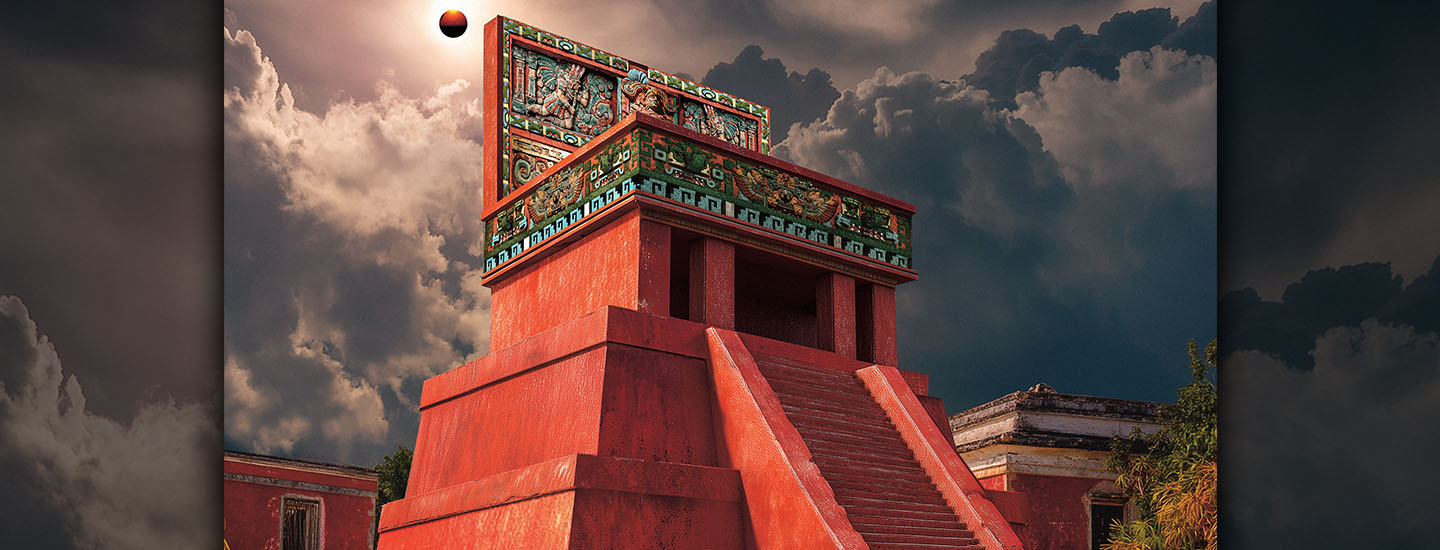
Illustration by Chris@kja-artists
STANDARDS
NCSS: Time, Continuity, and Change • People, Places, and Environments
Common Core: R.1, R.7

GEOGRAPHY | WORLD HISTORY
An Ancient Mystery
This building is part of a city in Guatemala that was hidden for centuries. What will it reveal about the Maya civilization and its people?
Question: What can buildings and other artifacts reveal about people who lived long ago?
Question: What can buildings and other artifacts reveal about people who lived long ago?
For centuries, the rainforest in northern Guatemala kept an ancient secret. Deep in its maze of thick trees and lush vegetation, thriving cities once stood—complete with pyramids, temples, farms, and courts for playing sports.
The cities belonged to the Maya, an ancient civilization that originated around 2000 B.C. in what is now Mexico and Central America (see map, below). The Maya built new cities as their empire grew, leaving these old ones behind. In time, the rainforest all but swallowed them up.
For centuries, the rainforest in northern Guatemala kept an ancient secret. Inside its maze of thick trees and lush vegetation, there were thriving cities. They had pyramids, temples, farms, and courts for playing sports.
The cities belonged to the Maya. That was an ancient civilization. It originated around 2000 B.C. in what is now Mexico and Central America (see map, below). The Maya built new cities as their empire grew. And they left these old ones behind. In time, the rainforest all but swallowed them up.
In recent years, however, rumors of the cities’ existence spread. “People gathering wild jungle fruits sometimes wandered through the area,” explains Milan Kováč. He is an archaeologist who studies the Maya civilization. “[They] told stories about strange stone structures.”
So Kováč and other archaeologists from Guatemala and Slovakia started searching, using a laser technology called lidar. (Lidar is short for light detection and ranging.) They sent planes equipped with lidar over the dense forest to shoot laser pulses into the ground below. The data from the lasers allowed the team to “see” part of a large ancient city beneath the trees. From there, they expanded their search with help from Indigenous people in the area.
In May 2025, the team announced their remarkable findings. They had located the remains of three Maya cities dating as far back as 3,000 years. They named the cities Los Abuelos, Petnal, and Cambrayal. Now the archaeologists are deep in another search—to discover what these ancient places can teach us about the early Maya people.
But in recent years, rumors spread that these cities existed. “People gathering wild jungle fruits sometimes wandered through the area,” explains Milan Kováč. He is an archaeologist. He studies the Maya civilization. “[They] told stories about strange stone structures.”
So Kováč and other archaeologists from Guatemala and Slovakia started searching. They used a laser technology called lidar. (Lidar is short for light detection and ranging.) They sent planes equipped with lidar over the dense forest. They shot laser pulses into the ground below. The data from the lasers allowed the team to “see” part of a large ancient city beneath the trees. From there, they expanded their search. They had help from Indigenous people in the area.
In May 2025, the team announced their remarkable findings. They had located the remains of three Maya cities. The cities dated as far back as 3,000 years. They named the cities Los Abuelos, Petnal, and Cambrayal. Now the archaeologists are deep in another search. They want to discover what these ancient places can teach us about the early Maya people.
Ahead of Their Time
The Maya were one of the most advanced civilizations in the early Americas. They developed innovative farming techniques and made significant achievements in math, science, and writing. But Spanish armies conquered the Maya, starting in the early 1500s. They destroyed some of the civilization’s records and introduced diseases that killed off many of its people.
The newly found cities offer insight into the civilization’s earliest time period. The Maya most likely built Los Abuelos, Petnal, and Cambrayal between 1000 and 500 B.C., at least 1,000 years before the empire reached its peak. They created the cities in a triangle, with about 3 miles between each site.
The Maya were one of the most advanced civilizations in the early Americas. They developed innovative farming techniques. They also made significant achievements in math, science, and writing. But Spanish armies conquered the Maya, starting in the early 1500s. They destroyed some of the civilization’s records. And they introduced diseases that killed off many of its people.
The newly found cities offer insight into the civilization’s earliest time period. The Maya most likely built Los Abuelos, Petnal, and Cambrayal between 1000 and 500 B.C. That was at least 1,000 years before the empire reached its peak. They created the cities in a triangle. There were about 3 miles between each site.
The Maya built new cities as their empire grew, leaving the old ones behind.
One City’s Secrets
Los Abuelos was the largest and most important of the three cities, researchers say. It served as a ceremonial center for the entire region and was “one of the last major Maya cities that had not yet been found,” Kováč explains. “Its history goes back to about 1000 B.C. That’s the very beginning of the complex Maya society.”
Los Abuelos was the largest and most important of the three cities, researchers say. It served as a ceremonial center for the entire region. It was “one of the last major Maya cities that had not yet been found,” Kováč explains. “Its history goes back to about 1000 B.C. That’s the very beginning of the complex Maya society.”
Guatemala Ministro de Cultura y Deportes
Los Abuelos is named for these sculptures of a man and a woman.
Archaeologists believe residents may have performed rituals. There is a large square in the center of the city, in front of a towering stone temple. Los Abuelos also has a group of buildings that were likely used as an observatory for studying space. The Maya tracked the movements of the sun, including zenith passages, to help develop a 365-day calendar. A zenith passage is the moment twice a year when the sun passes directly overhead in certain parts of the world.
It makes sense that a ceremonial center like Los Abuelos would have structures for tracking objects in the heavens, Kováč says. “To the Maya, these objects were not just rocks in space—they were gods. The movements of the sun, Venus, and the moon were connected to powerful stories about divine beings and events happening in the sky.”
Archaeologists believe residents may have performed rituals. There is a large square in the center of the city. It is in front of a towering stone temple. Los Abuelos also has a group of buildings that were likely used as an observatory for studying space. The Maya tracked the movements of the sun, including zenith passages. That helped them develop a 365-day calendar. A zenith passage is the moment twice a year when the sun passes directly overhead in certain parts of the world.
It makes sense that a ceremonial center like Los Abuelos would have structures for tracking objects in the heavens, Kováč says. “To the Maya, these objects were not just rocks in space—they were gods. The movements of the sun, Venus, and the moon were connected to powerful stories about divine beings and events happening in the sky.”
The three cities offer insight into the earliest time period of the Maya civilization.
Researchers named the city Los Abuelos, which is Spanish for “The Grandparents,” because of two sculptures they found there, of a man and a woman. The sculptures are believed to represent significant ancestors of the city’s people and are a window into early Maya art, experts say.
The team also found a human burial site and the remains of two felines. In addition, excavations in Los Abuelos have turned up more sculptures, pottery, shells, and arrowheads. Archaeologists have even uncovered an altar in the shape of a frog.
The ruins also include a stela, an upright stone slab with writing on it. The team plans to translate the stela’s inscription.
Researchers named the city Los Abuelos. That is Spanish for “The Grandparents.” They chose that name because of two sculptures they found there. The sculptures are of a man and a woman. They are believed to represent significant ancestors of the city’s people. And they are also a window into early Maya art, experts say.
The team also found a human burial site and the remains of two felines. In addition, excavations in Los Abuelos have turned up more sculptures, pottery, shells, and arrowheads. Archaeologists have even uncovered an altar in the shape of a frog.
The ruins also include a stela. That is an upright stone slab with writing on it. The team plans to translate the stela’s inscription.
Additional Artifacts
The settlements of Petnal and Cambrayal are smaller than Los Abuelos, but researchers say their ruins still offer important clues. Petnal was probably a political center, Kováč explains. That city boasts a stone pyramid that stands about 100 feet tall. At the top is a well-preserved room with remains of wall paintings colored in black, red, and white.
Meanwhile, in Cambrayal, the team found a network of canals, or human-made waterways, stretching almost 200 feet. The canal system may have had a royal purpose. It begins at the top of a palace, where a water reservoir was located. Archaeologists suspect the stucco-lined canals may have been used to drain waste away—an ancient version of a flush toilet.
The settlements of Petnal and Cambrayal are smaller than Los Abuelos. But researchers say their ruins still offer important clues. Petnal was probably a political center, Kováč explains. That city boasts a stone pyramid that stands about 100 feet tall. At the top is a well-preserved room with remains of wall paintings colored in black, red, and white.
Meanwhile, in Cambrayal, the team found a network of canals. Those are human-made waterways. They stretch almost 200 feet. The canal system may have had a royal purpose. It begins at the top of a palace, where a water reservoir was located. Archaeologists suspect the stucco-lined canals may have been used to drain waste away. That is an ancient version of a flush toilet.
Danny Lehman/Getty Images
Maya girls sell woven fabricin Guatemala.
The Maya Today
An estimated 8 million people today can trace their roots back to the ancient Maya, according to the MesoAmerican Research Center. Most live in their ancestral homelands in Belize, El Salvador, Guatemala, Honduras, and southern Mexico. In Guatemala, the Maya make up about 40 percent of the population and speak more than 20 different versions of their native language.
The modern Maya also live in parts of the United States and in other countries around the world. Many of them continue to preserve and pass down the culture and traditions of their ancestors.
“The ancient Maya are not a mysterious lost civilization,” explains Luke Auld-Thomas, an anthropologist who studies the Maya. “The Maya civilization and the Maya people today have a direct historical line connecting them.”
An estimated 8 million people today can trace their roots back to the ancient Maya, according to the MesoAmerican Research Center. Most live in their ancestral homelands in Belize, El Salvador, Guatemala, Honduras, and southern Mexico. In Guatemala, the Maya make up about 40 percent of the population and speak more than 20 different versions of their native language.
The modern Maya also live in parts of the United States and in other countries around the world. Many of them continue to preserve and pass down the culture and traditions of their ancestors.
“The ancient Maya are not a mysterious lost civilization,” explains Luke Auld-Thomas, an anthropologist who studies the Maya. “The Maya civilization and the Maya people today have a direct historical line connecting them.”
Solving the Puzzle
Researchers are still studying the artifacts from the three cities. They are confident that they will unveil new information about the civilization’s early people. Many of the other major Maya cities that have already been studied arose about 1,000 years after these sites.
“Every little piece we can obtain from the excavations is fundamental, like a piece of the great puzzle we are putting together,” explains archaeologist Dora García. With Kováč, she is co-director of the team studying the three cities.
Kováč is also eager to continue to learn from the ruins that lay hidden for so long. “Together, these three cities tell a story that lasted nearly 2,000 years,” he says. “It’s like watching Maya history unfold.”
Researchers are still studying the artifacts from the three cities. They are confident that they will unveil new information about the civilization’s early people. Many other major Maya cities have already been studied. And they arose about 1,000 years after these sites.
“Every little piece we can obtain from the excavations is fundamental, like a piece of the great puzzle we are putting together,” explains archaeologist Dora García. With Kováč, she is co-director of the team studying the three cities.
Kováč is also eager to continue to learn from the ruins that lay hidden for so long. “Together, these three cities tell a story that lasted nearly 2,000 years,” he says. “It’s like watching Maya history unfold.”
Interactive Quiz for this article
Click the Google Classroom button below to share the Know the News quiz with your class.
Download .PDF