
Question: How can eyewitness accounts help us understand major events in history?
NCSS: Time, Continuity, and Change • Individual Development and Identity
Common Core: R.6, R.7, R.9, W.1
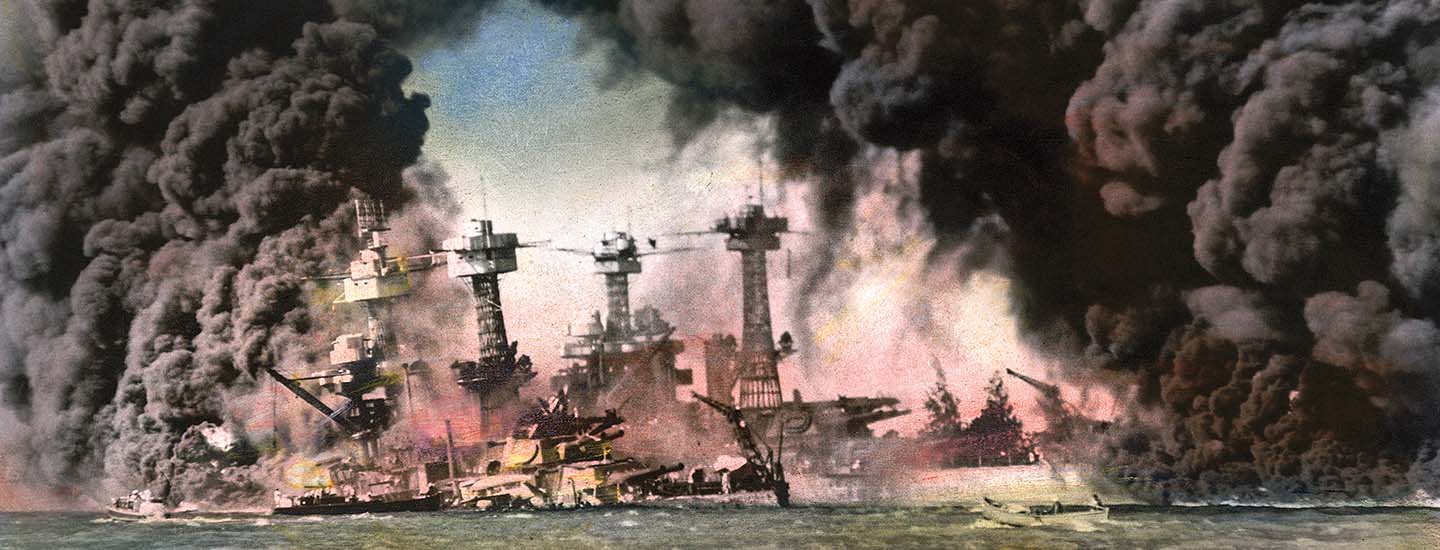
U.S. battleships under fire at the Pearl Harbor Naval Base on December 7, 1941
Sarin Images/The Granger Collection
STANDARDS
NCSS: Time, Continuity, and Change • Individual Development and Identity
Common Core: R.6, R.7, R.9, W.1

U.S. HISTORY
Voices From Pearl Harbor
In 1941, Japan attacked a U.S. Navy base in Hawaii, killing more than 2,400 people and launching the United States into World War II. These are the stories of people who were there.
Question: How can eyewitness accounts help us understand major events in history?
Jim McMahon/Mapman®
December 7, 1941, was one of the most shocking days in American history. The United States wasn’t at war, but the country suddenly found itself under attack. Early that morning, Japan launched a massive surprise strike on Pearl Harbor, the U.S. naval base on the Hawaiian island of Oahu.
At the time, it was the deadliest attack on the U.S. outside of war—surpassed only by the 9/11 terrorist attacks six decades later. Japanese aircraft bombed and torpedoed Pearl Harbor, killing more than 2,400 people—mostly U.S. military members. The strike also badly damaged or destroyed more than 20 ships and nearly 350 aircraft, a significant loss for the U.S. Navy’s fleet in the Pacific Ocean.
Grief and anger quickly spread across the nation and the Hawaiian Islands, then a U.S. territory. The next day, President Franklin D. Roosevelt asked Congress to declare war on Japan. That declaration would quickly plunge Americans into World War II (1939-1945), the deadliest conflict in history.
The U.S. joined the Allied powers, taking a leading role alongside the United Kingdom and the Soviet Union. Japan, meanwhile, was already part of the Axis powers, led by Germany and Italy. Much of the fighting was concentrated in Europe. But thousands of miles away, Japan was using the conflict to expand its empire in Asia.
AP Images (newspaper); Shawshots/Alamy Stock Photo (warplanes)
Japan attacked with about 350 warplanes.
The U.S. and Japan
Tensions between the U.S. and Japan had started several years before the Pearl Harbor attack. Both nations wanted to have influence over eastern Asia, and the U.S. grew alarmed when Japan started invading countries and territories there. In 1937, Japan attacked China. Then in September 1940, it invaded Indochina, a French colony that later became Cambodia, Laos, and Vietnam. Days later, Japan signed a pact with Germany and Italy. Those nations were already at war with the United Kingdom, a longtime U.S. ally.
Roosevelt decided that Japan’s actions were a threat that could not be ignored. In the summer of 1941, he blocked Japan from buying U.S. oil and demanded that Japan withdraw from the land it had seized. Japan refused, and by November, its leaders had come to a fateful decision: If the U.S. wouldn’t get out of the way of their growing empire, they had no choice but to attack it.
The Greatest Damage
By this time, the Japanese had been preparing for months, practicing air raids and using spies to study Pearl Harbor. They knew the base’s layout, including where the planes, ships, and fuel were kept. Striking those targets would allow them to cause the greatest damage.
Then, on December 7, Japan sprang into action. At 7:55 a.m., its first wave of planes reached Pearl Harbor. Many of the planes rained torpedoes and bombs on the base’s aircraft and ships. Others targeted everyone in sight with machine gun fire. About an hour later, a second wave of Japanese planes continued the assault. By the time the attack ended around 10 a.m., the Japanese had sunk four U.S. battleships—with thousands of troops still on board.
The tragedy touched Americans across the nation and ultimately altered the course of history. What was it like to have been at Pearl Harbor on December 7, 1941? Read on to explore the accounts of people who survived the attack.
Photo12/Universal Images Group via Getty Images
Smoke fills the air as Japan ambushes Pearl Harbor.
Under Fire
Al Rodrigues, 21
Courtesy of the family of Al Rodrigues
Al Rodrigues
Rodrigues, a Navy sailor who grew up in Hawaii, had been working all night in the base’s supply department. It was his job to issue ammunition and equipment. Rodrigues was just finishing his shift when the first wave of Japanese planes struck. At first, he was shocked. Then he leaped into action.
"I was about to sit down for my breakfast in the mess hall when we heard the alarms sound. We all ran to the armory where the ammunitions were held, and they issued ammo and guns to the sailors.
Initially, I was terrified. You don’t have much time to think. You were doing whatever it took to stay alive. I was shooting at the Japanese planes that were flying so low you could see the pilots’ faces. Later I was sent to the supply building to issue supplies to anyone and everyone. [I spent my childhood on the Hawaiian island of Kauai and] I couldn’t help thinking of my friends from school and the fact that 50 percent of them were second-generation Japanese and close to me.
To this day, I jump out of my skin when being awakened suddenly, because of my emotional ties to the loud bombs of the war.”
Bettmann Archive/Getty Images
The USS West Virginia (left) and USS Tennessee after the attack
Fighting Back
Doris “Dorie” Miller, 22
Everett Collection Inc/Alamy Stock Photo
Doris Miller
The enemy’s torpedoes and bombs caused immediate, catastrophic damage, including to battleships in the harbor. Miller was on one of them, the USS West Virginia. Originally from Texas, Miller was a mess attendant whose job was to serve food to naval officers and clean up after them. As a Black man, he had few other opportunities in the Navy at that time. But with the West Virginia in danger, Miller rushed to the deck and started firing a machine gun for the first time in his life.
"Several of the men had lost their lives—including some of the high officers—when the order came for volunteers from below [deck] to come on the upper deck and help fight the Japanese.
Without knowing how, I did it. It must have been God’s strength and mother’s blessing. I ran up . . . and I started to fire the big guns. . . . It wasn’t hard. I just pulled the trigger, and [it] worked fine. Those [Japanese] planes were diving pretty close to us.”
Rescuing Survivors
Ivan Arnold Harris, 21
US Navy
Ivan Arnold Harris
By 8 a.m., flames and suffocating black smoke filled the air. Oil from damaged ships gushed into the water, spreading and catching fire. Before the attack started, Harris, a Colorado native, had been patrolling the harbor with a crew in a small boat called a launch. Now he and his men raced through gunfire to pick up survivors.
"Right next to us was the [USS] Arizona, all ablaze. You could feel the heat of it. A man was clinging [to a rope]. We . . . pulled him on board our launch.
And then we went [to] the West Virginia. [It] was ablaze. I . . . noticed all that burning oil coming toward us. And a fellow on board jumps overboard and says, ‘Wait for me.’ He grabs the line.
[Then] I headed for the [USS] Oklahoma. . . . All of a sudden, I realize the Oklahoma capsized. All we see is this big hull. Boy, I felt as if someone had kicked me in the stomach. You don’t just kill a battleship that way.
Well, we started picking up survivors. . . . We had so many we had them hanging on [the upper edge] of the launch.
As we turned to go toward [a] dock, the Arizona exploded again. . . . The shock of the bomb made our launch move [but] the heat was at our back now because I was getting out of there in a hurry. [The Arizona sank, killing 1,177 sailors aboard.] If I hadn’t taken that fellow off, that’s what would have happened to him too.
Bombs and torpedoes . . . were dropping all around us but . . . I wasn’t being brave, I was just doing what I was told to do, what I had to do.”
Science History Images/Alamy Stock Photo
Sailors in small boats rush to save people.
Fleeing Home
Dorinda Makanaonalani Nicholson, 6
Courtesy of the Mahalo Family
Dorinda Makanaonalani Nicholson and her father
Dorinda lived with her parents and younger brother in a house at the harbor. Around 7:55 a.m., Dorinda’s father ran into the kitchen, saying he had been awakened by the sound of bombs. The explosions shook their house. The family fled, driving to a nearby field of sugarcane for shelter.
"From where we were, we could see the oily black smoke from the burning ships.
Finally, the announcer came on the radio. “This is no drill,” he said. . . . Residents were ordered to not leave our houses, turn our lights on, or use the phone. About that time, some soldiers came and told us that we needed to go to the next town over. I asked if I could go to our house to get my dog, Hula Girl. But the area was on fire and no one was allowed back.
Rumors spread [that] we’d have Japanese soldiers surrounding us when the sun came up.”
Helping the Wounded
Kathryn Mary Doody, 25
Courtesy of the Doody family
Kathryn Mary Doody
Injured sailors were rushed to nearby hospitals, including Tripler Army Hospital in Honolulu, where Doody worked as an Army nurse. The Maryland native received a call to report immediately to the hospital.
"They had as many stretchers as they could get in one room. You know, all the rooms were filled up with wounded men. [They] told me which [operating] room to go in, and so I got scrubbed up and went in. [During the operation], a plane flew over, and we heard the bullets hitting the pavement. And the doctor [who] was working ducked his head. . . . He said, ‘That was a close one.’ But none of it hit the hospital.
We worked until midnight that night. . . . [When we left, soldiers] were guarding the hospital. . . . The next morning, we started all over again, you know, with the rooms being filled with wounded soldiers.”
Ferrying Rescuers
Robert Abbott Coates, 20
US Navy
Robert Abbott Coates
Shortly before 9 a.m., a second wave of planes attacked. Coates, a sailor from Idaho, was returning to base from Honolulu, where he had been on leave. Unable to reach his ship, the USS Nevada, Coates rushed to a rescue boat to help free survivors from the sinking battleships.
"I was ferrying over crews [from shore]. The Oklahoma was capsized, and [the crews] were trying to chisel through the bottom, cut through with cutting torches to get some of those guys [who] were trapped in there out.
I spent all day doing that. [The next day], I was still ferrying people back and forth. I had not eaten, I did not have time to eat, and I was thirsty and everything and I had not slept. . . .
The big initial shock for me was when I [first reached the base] and I could see what was going on. I cannot describe the feeling I had. I was in shock. And all I could think of was, ‘Boy, I want to go home,’ and my home was on that ship.”
After the Attack
Many Pearl Harbor survivors went on to serve in World War II. Germany surrendered in May 1945. But Japan continued to fight until the U.S. destroyed two of its cities with atomic bombs. Japan surrendered in September 1945, ending the war. Today the Pearl Harbor National Memorial on Oahu is a lasting reminder of the people who lost their lives and the legacy of their sacrifice. Dorinda, the youngest eyewitness quoted here, is now 90 and continues to share her story.
SOURCES: Al Rodrigues (2017); Dorinda Makanaonalani Nicholson (2025): Scholastic Magazines+; Doris Miller: U.S. Naval Institute; Ivan Arnold Harris (AFC/2001/001/35001); Kathryn Mary Doody (AFC 2001/001/23308); Robert Abbott Coates (AFC/2001/001/489): Oral history interviews, Veterans History Project collection, American Folklife Center, Library of Congress
YOUR TURN
Analyze Primary Sources
What details from each of the accounts stand out to you? Why? How does each person’s description help you understand the impact that Pearl Harbor had on them as individuals and on the country as a whole?
Interactive Quiz for this article
Click the Google Classroom button below to share the Know the News quiz with your class.
Download .PDF