

Question: How does overcrowding affect people in Lagos, Nigeria?
Question: How does overcrowding affect people in Lagos, Nigeria?
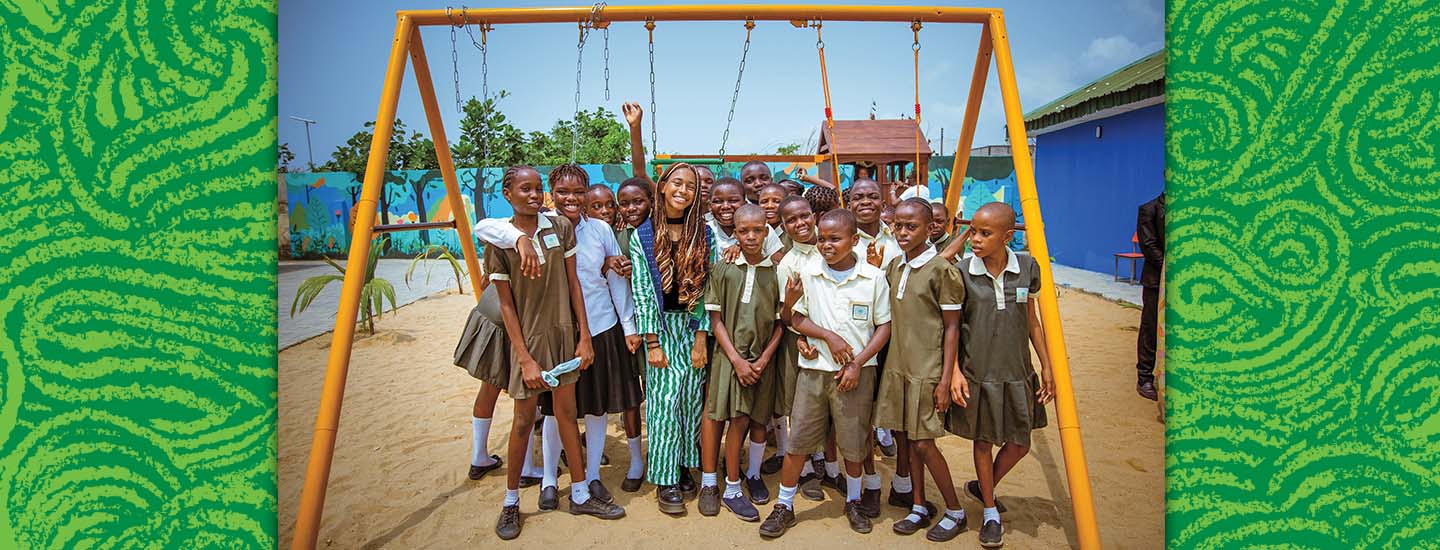
Amara Nwuneli (in stripes) celebrates her park in Lagos, Nigeria, with local kids in March 2025.
Shutterstock.com (background); Photo by Peter Odije Okosun. Courtesy of The World Around Young Climate Prize (Nwuneli with kids)
STANDARDS
NCSS: People, Places, and Environments • Individual Development and Identity
Common Core: R.3, R.7

WORLD NEWS
A Place to Play
In the bustling city of Lagos, Nigeria, many children have nowhere to play outside. Amara Nwuneli is on a mission to change that, one park at a time.
Question: How does overcrowding affect people in Lagos, Nigeria?
Question: How does overcrowding affect people in Lagos, Nigeria?
Jim McMahon/Mapman®
Growing up, Amara Nwuneli longed to be outside. She daydreamed about playing tag with her friends, riding bikes, or even just taking a walk in a park.
But instead Amara spent nearly every day after school cooped up indoors. Why? The teen is from Lagos (LAY-gahss), Nigeria, a megacity and one of the most densely populated places in Africa. A megacity is a city with more than 10 million residents.
Lagos is about the same size as Los Angeles, California, but has more than four times as many people. An estimated 17 million residents are jammed into Lagos. That leaves little room for parks and other outdoor areas for kids to play.
Growing up, Amara Nwuneli longed to be outside. She daydreamed about playing tag with her friends and riding bikes. She even just wanted to take a walk in a park.
But instead Amara spent nearly every day after school cooped up indoors. Why? The teen is from Lagos (LAY-gahss), Nigeria. That is a megacity and one of the most densely populated places in Africa. A megacity is a city with more than 10 million residents.
Lagos is about the same size as Los Angeles, California. But it has more than four times as many people. An estimated 17 million residents are jammed into Lagos. That leaves little room for parks and other outdoor areas for kids to play.
Amara, now 18, remembers what it felt like to be stuck inside. “I was agitated and restless all the time,” she says. “It wasn’t fun.”
So starting in the fall of 2024, the teen set out to build something many children in Lagos had never seen—a park. She wanted to ensure that other kids in her community had somewhere to run around. “I wanted them to have a place where they can experience nature, play, and chill out with their friends,” Amara says.
Amara is now 18. She remembers what it felt like to be stuck inside. “I was agitated and restless all the time,” she says. “It wasn’t fun.”
So starting in the fall of 2024, the teen set out to build a park. That is something many children in Lagos had never seen. She wanted to ensure that other kids in her community had somewhere to run around. “I wanted them to have a place where they can experience nature, play, and chill out with their friends,” Amara says.
Big City Challenges
Amara had taken on challenges in her community before. In 2020, when she was 13, a major flood swept through Lagos, destroying her home and other buildings. Amara recorded and shared videos of the damage online, raising about $5,000 to help rebuild two local schools. Later that year, she founded an environmental nonprofit with her friends called Preserve Our Roots to plant trees and organize beach cleanups.
She was determined to once again make a difference. Finding a place to build a park wasn’t easy, however. Less than 3 percent of Lagos is protected as green space—undeveloped areas with grass and trees. And the city’s population is growing rapidly.
Lagos’s lack of free space is decades in the making. In 1950, only about 300,000 people lived in the city. But over time, millions of people moved there, many of them looking for work. Today Lagos is a key hub for industries, including technology and manufacturing.
But the city’s population has grown much faster than its infrastructure, such as housing. As a result, about 66 percent of residents live tightly packed together in slums, according to World Population Review. That group tracks global population data. The makeshift housing settlements often lack running water and other basic necessities.
Amara had taken on challenges in her community before. In 2020, a major flood swept through Lagos. She was 13. It destroyed her home and other buildings. Amara recorded and shared videos of the damage online. She raised about $5,000 to help rebuild two local schools. Later that year, she founded an environmental nonprofit with her friends called Preserve Our Roots. They planted trees and organized beach cleanups.
She was determined to once again make a difference. But finding a place to build a park was not easy. Less than 3 percent of Lagos is protected as green space. That is undeveloped areas with grass and trees. And the city’s population is growing rapidly.
Lagos’s lack of free space is decades in the making. In 1950, only about 300,000 people lived in the city. But over time, millions of people moved there. Many of them came looking for work. Today Lagos is a key hub for industries like technology and manufacturing.
But the city’s population has grown much faster than its infrastructure, such as housing. As a result, about 66 percent of residents live tightly packed together in slums. That is according to World Population Review. This group tracks global population data. The makeshift housing settlements often lack running water and other basic necessities.
James Marshall/Getty Images
People shop at an outdoor market in Lagos, Nigeria. The city’s population is set to double by 2050.
Overcrowding in Megacities
Here’s a look at this worldwide issue—and one potential solution.
THE PROBLEM
33: Number of megacities, up from 8 in 1975. The biggest is Jakarta, Indonesia.
623 million: Number of people globally who live in megacities
SOURCE: U.N. World Urbanization Prospects 2025
33: Number of megacities, up from 8 in 1975. The biggest is Jakarta, Indonesia.
623 million: Number of people globally who live in megacities
SOURCE: U.N. World Urbanization Prospects 2025
THE CAUSES
Urban Migration: People in rural areas often move to nearby cities for opportunities such as higher-paying jobs, better schools, and more accessible health care.
Population Growth: Populations are surging in the countries where many megacities are located. In Nigeria, for example, women have nearly 5 children on average. The global average is 2.2 children.
Climate Change: Many people try to escape droughts and other effects of climate change by relocating to cities. But intense heat, flooding, and other climate effects can be just as bad or even worse in urban areas.
Urban Migration: People in rural areas often move to nearby cities for opportunities such as higher-paying jobs, better schools, and more accessible health care.
Population Growth: Populations are surging in the countries where many megacities are located. In Nigeria, for example, women have nearly 5 children on average. The global average is 2.2 children.
Climate Change: Many people try to escape droughts and other effects of climate change by relocating to cities. But intense heat, flooding, and other climate effects can be just as bad or even worse in urban areas.
ONE SOLUTION
To accommodate more people, some architects are building up instead of out. High-rise towers in Lagos and some other megacities around the world offer apartments and office space stretching hundreds of feet up. Many of the buildings incorporate trees, plants, and green space on the roofs and terraces to improve air quality and residents’ well-being.
To accommodate more people, some architects are building up instead of out. High-rise towers in Lagos and some other megacities around the world offer apartments and office space stretching hundreds of feet up. Many of the buildings incorporate trees, plants, and green space on the roofs and terraces to improve air quality and residents’ well-being.
Seeking a Space
Amara was convinced that children living in those slums—and all young people in the city—needed a park. She approached city officials with her idea, armed with a list of ways in which the residents of Lagos would benefit.
Parks give people a way to enjoy the outdoors and learn about the environment, Amara says. They also improve people’s moods and create a sense of community, she adds. Plus, research shows that children who live near parks are more likely to get daily exercise.
The local government offered Amara a location to use. But officials wouldn’t let her build anything permanent on the land, in case they needed it back. So Amara looked for other options. Eventually, an organization in Lagos that works with disadvantaged children agreed to provide land. The space is near a busy outdoor market in the Ikota neighborhood.
That property, however, came with a catch. The site was in a muddy, flood-prone area. And it was being used as a garbage dump.
Amara was convinced that children living in those slums needed a park. And all young people in the city needed it. She approached city officials with her idea. She was armed with a list of ways in which the residents of Lagos would benefit.
Parks give people a way to enjoy the outdoors and learn about the environment, Amara says. They also improve people’s moods. They create a sense of community, she adds. Plus, research shows that children who live near parks are more likely to get daily exercise.
The local government offered Amara a location to use. But officials would not let her build anything permanent on the land, in case they needed it back. So Amara looked for other options. Eventually, an organization in Lagos that works with disadvantaged children agreed to provide land. The space is near a busy outdoor market in the Ikota neighborhood.
But that property came with a catch. The site was in a muddy, flood-prone area. And it was being used as a garbage dump.
Photo by Peter Odije Okosun. Courtesy of The World Around Young Climate Prize
Children swing at the playground in March 2025.
From Trash to Treasure
Amara was not discouraged—far from it, in fact. She decided to repurpose as many materials from the dump as she could to create the playground equipment.
With a team of volunteers and local artisans ready to help, Amara got to work. Together the group hauled out piles and piles of rotten food and garbage to clear the space. Then they reused what they could. Old tires were made into swings, and heaps of wood were sanded down and hammered into benches.
Next, painters decorated the space with colorful murals of blue skies and rainbows. And Amara and other members of Preserve Our Roots planted 300 trees along the park’s border. Trees provide shade and help absorb rainwater to reduce flooding.
The G.R.E.E.N. Sustainability Park opened in March 2025. (The acronym stands for Growth, Recycle, Educate, Empower, and Nature.) Every day, boys and girls race through the gates for the swings, the bright-yellow slide, and the multicolored climbing wall. They also gather in the park for volunteer-led classes on ways to protect the environment.
Amara was not discouraged. Far from it, in fact. She decided to repurpose as many materials from the dump as she could to create the playground equipment.
Amara got to work. She had a team of volunteers and local artisans ready to help. Together the group cleared the space. They hauled out piles and piles of rotten food and garbage. Then they reused what they could. Old tires were made into swings. Heaps of wood were sanded down and hammered into benches.
Next, painters decorated the space with colorful murals of blue skies and rainbows. And Amara and other members of Preserve Our Roots planted 300 trees along the park’s border. Trees provide shade. And they help absorb rainwater to reduce flooding.
The G.R.E.E.N. Sustainability Park opened in March 2025. (The acronym stands for Growth, Recycle, Educate, Empower, and Nature.) Every day, boys and girls race through the gates for the swings and the bright-yellow slide. They run to the multicolored climbing wall. They also gather in the park for volunteer-led classes on ways to protect the environment.
Expanding Her Reach
Photo by Peter Odije Okosun. Courtesy of The World Around Young Climate Prize
A child climbs at the playground in March 2025.
The playground is a success, but Amara says her work isn’t finished. She is a student at the University of Chicago in Illinois, where she is studying sustainable development. That is a method of building that doesn’t completely use up or destroy natural resources. Amara plans to use what she learns to continue constructing parks back home.
And she recently received more support to achieve that goal. Amara won $12,500 last year from the Earth Prize. That international competition recognizes teens for their work to improve the environment.
Being outdoors in nature is something everyone should have the right to experience and enjoy, Amara says. The benefits show on the faces of the children at the park, she adds. One 11-year-old boy who wants to be an artist when he grows up told her that he now has a place where he can sit under the trees and draw.
“Younger me would have really appreciated having a park like this,” Amara says. “Kids can just be kids here.”
The playground is a success. But Amara says her work is not finished. She is a student at the University of Chicago in Illinois. She is studying sustainable development. That is a method of building that does not completely use up or destroy natural resources. Amara plans to use what she learns to continue constructing parks back home.
And she recently received more support to achieve that goal. Amara won $12,500 last year from the Earth Prize. That is an international competition. It recognizes teens for their work to improve the environment.
Being outdoors in nature is something everyone should have the right to experience and enjoy, Amara says. The benefits show on the faces of the children at the park, she adds. One 11-year-old boy told her that he now has a place where he can sit under the trees and draw. He wants to be an artist when he grows up.
“Younger me would have really appreciated having a park like this,” Amara says. “Kids can just be kids here.”
YOUR TURN
Think Like Amara
What improvements could make life better for the children and teens in your neighborhood, town, or city? Brainstorm ideas with a partner, then choose one to present to the class. Be sure to explain what your idea is, how you could carry it out, and why it would improve life for people in your community.
What improvements could make life better for the children and teens in your neighborhood, town, or city? Brainstorm ideas with a partner, then choose one to present to the class. Be sure to explain what your idea is, how you could carry it out, and why it would improve life for people in your community.
Interactive Quiz for this article
Click the Google Classroom button below to share the Know the News quiz with your class.
Download .PDF