

Question: What are some benefits of aging populations? What are some challenges?
NCSS: People, Places, and Environments
Common Core: R.1, R.7
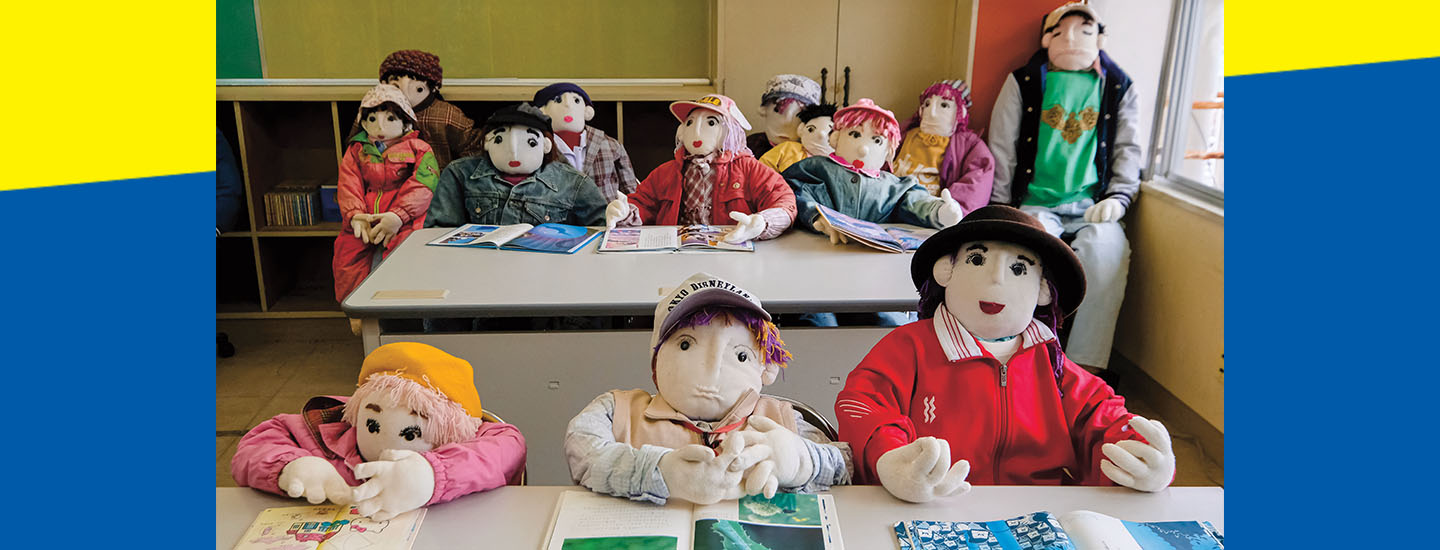
Dolls sit in a classroom in Nagoro, Japan. Not a single baby has been born in the village in two decades.
Kazuhiro Nogi/AFP via Getty Images
STANDARDS
NCSS: People, Places, and Environments
Common Core: R.1, R.7

WORLD NEWS | GEOGRAPHY
Where Are the Kids?
Around the world, people are living longer but having fewer babies. What does that mean for the future?
Question: What are some benefits of aging populations? What are some challenges?
Walk through the village of Nagoro, Japan, and you’ll see kids everywhere. They’re slouched behind desks in classrooms, outside getting ready to skateboard, and even lined up to play tug-of-war.
But take a closer look and you’ll see these aren’t kids at all. They’re life-sized dolls! A local woman makes them out of wood, newspaper, and wire and poses them around town.
Why? Nagoro has no human children. Not a single one.
The village’s school closed in 2012 after the last two sixth-graders graduated. And it will not need to reopen anytime soon. No babies have been born in Nagoro in about 20 years.
Nagoro’s situation is extreme, but it isn’t unique. In nearly every country, people are having fewer children than ever. In the 1970s, the average household worldwide had five kids. Today the average is 2.2.
At the same time, the number of older people is growing, thanks to advances in health care. For example, demographers estimate that 40 percent of the population in South Korea will be 65 or older by 2050.
The fact that people are living longer is a positive change, many experts say. But these shifts also mean that in the future, there may be fewer people to fill jobs, start families, and help care for the elderly. That could affect the size of countries’ populations for generations to come. Demographers and government officials alike are trying to plan for those changes.
“These are significant challenges,” explains David Lam, a global population expert at the University of Michigan. “We need to think about how to adjust.”
By 2080, the number of people age 65 or older is expected to surpass the number of kids and teens worldwide.
SOURCE: United Nations
Population Shifts
The world hasn’t always been short on babies. Following World War II (1939-1945), birth rates surged around the globe. The spike was so high in the United States that it inspired the name of an entire generation! Now in their 60s, 70s, and early 80s, those people are known as baby boomers.
In the decades after, more opportunities began opening up for women in many parts of the world. As they pursued education and careers, some women opted to have fewer children or no children at all. Birth rates began to fall.
Adding to the decline, the cost to raise children increased. Many couples chose to have fewer babies because they could not afford to support large families.
Meanwhile, people began living longer. In 1950, people worldwide lived to about 46 years old on average. Today they live to about 73 years old.
Ayman Oghanna
Students play at recess in Lemnos, Greece. One grade in their school has just two students.
Challenges Ahead
Though having healthier older people is largely good news, the population shift is creating challenges—particularly in Asia and Europe.
One of the biggest problems is that a country can end up without enough workers to support its economy. Take China, for example, a country of 1.4 billion people. The Asian nation has the world’s second-largest economy after that of the U.S. But it stands to lose more than 200 million workers in the next three decades as older residents begin to retire.
Another issue some nations are facing is not having enough health care workers to support elderly populations. Japan, with one of the highest percentages of aging populations, is already facing a shortage of nurses.
The population shift also affects young people directly. Countries with fewer kids and teens may cut back on resources for those age groups. For example, Greece recently announced plans to close more than 700 schools because there aren’t enough students to fill classrooms.
Planning for the Future
To address these issues, some countries are encouraging their citizens to have larger families. China and Italy are offering financial incentives such as cash bonuses to persuade people to have more kids.
Other countries are turning to automation to care for residents as they age. Japan is developing AI-powered robots to help treat elderly hospital patients.
Experts say these tactics could help but that older people will also need to adapt. Adults may need to work longer and save more money for retirement. Those changes may take some getting used to, Lam says, but they’re worth it.
“People are not just living longer but are also healthier at old age,” he explains. “This is something most people have always wanted.”
Interactive Quiz for this article
Click the Google Classroom button below to share the Know the News quiz with your class.
Download .PDF