
Question: What water challenges do people face? How is #TeamWater helping?
Question: What water challenges do people face? How is #TeamWater helping?
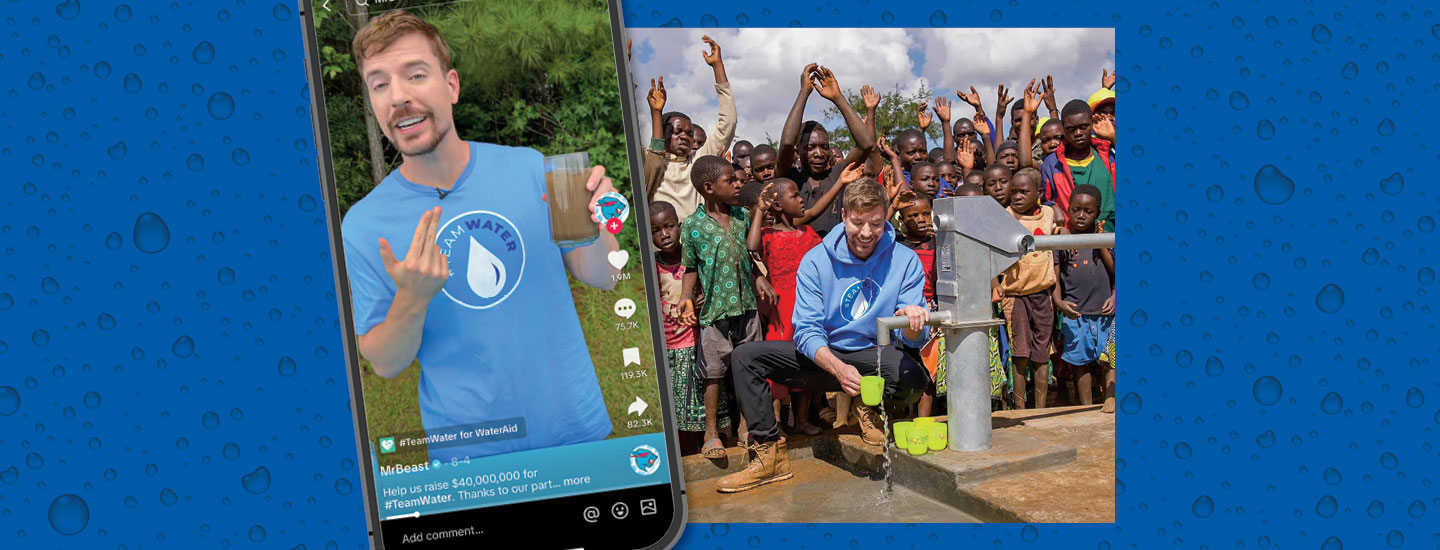
Left: YouTube star Jimmy Donaldson, also known as MrBeast, recently helped raise money for water projects around the world. Right: MrBeast draws clean water from a well in Malawi, a country in Africa.
via TikTok (MrBeast); Shutterstock.com (phone, background); Courtesy of Beast Industries (Malawi)
STANDARDS
NCSS: People, Places, and Environments • Individuals, Groups, and Institutions
Common Core: R.5

WORLD NEWS
What If Your Water Looked Like This?
Billions of people around the world don’t have access to clean water. Here’s how your favorite YouTubers are working to change that.
Question: What water challenges do people face? How is #TeamWater helping?
Question: What water challenges do people face? How is #TeamWater helping?
Courtesy of Beast Industries
YouTube star Mark Rober helped lead the #TeamWater project.
How many times do you use water in a day? You likely brush your teeth after you wake up. Sip from a water bottle at school. Maybe take a shower before bed.
But what if you turned on your faucet and nothing came out? Or if you had to walk miles to get water, then lug heavy containers of it back home? That’s the reality for many people around the globe.
About 2.1 billion people worldwide lack access to safe water, according to the World Health Organization. Those people constantly have to think about how much water they use and how much they have left. Some walk or drive for hours to get water—weekly or even daily—taking time away from school and work. And millions of people get sick from drinking contaminated water because it is all that they have.
How many times do you use water in a day? You likely brush your teeth after you wake up. Sip from a water bottle at school. Maybe take a shower before bed.
But what if you turned on your faucet and nothing came out? Or if you had to walk miles to get water, then lug heavy containers of it back home? That is the reality for many people around the globe.
About 2.1 billion people worldwide lack access to safe water. That is according to the World Health Organization. Those people constantly have to think about how much water they use and how much they have left. Some walk or drive for hours to get water. They do this weekly or even daily. That takes time away from school and work. And millions of people get sick from drinking contaminated water. It is all they have.
YouTube stars Jimmy Donaldson (also known as MrBeast) and Mark Rober recently stepped up to help. This past August, they launched the #TeamWater campaign, rallying creators and fans to raise money for water projects around the globe. “Everyone in the world deserves clean water,” MrBeast says.
Thousands of #TeamWater creators posted content to YouTube, TikTok, and other platforms, encouraging their combined 2 billion followers to donate. And it worked. The global fundraiser pulled in more than $40 million. That’s enough money to provide safe water for 2 million people for decades.
Now #TeamWater is working with the nonprofit WaterAid and other groups to use the money to improve water access in more than 25 countries. Read on to learn about their efforts.
YouTube stars Jimmy Donaldson (also known as MrBeast) and Mark Rober recently stepped up to help. This past August, they launched the #TeamWater campaign. They rallied creators and fans to raise money for water projects around the globe. “Everyone in the world deserves clean water,” MrBeast says.
Thousands of #TeamWater creators posted content to YouTube, TikTok, and other platforms. They encouraged their combined 2 billion followers to donate. And it worked. The global fundraiser pulled in more than $40 million. That is enough money to provide safe water for 2 million people for decades.
Now #TeamWater is working with the nonprofit WaterAid and other groups to use the money to improve water access in more than 25 countries. Read on to learn about their efforts.
WaterAid/Ram Saran Tamang
A woman in Devichour, Nepal, carries water in 2025.
Nepal
The Problem: Water sources in the nation’s rural communities can be contaminated and difficult to access.
Jim McMahon/Mapman®
YouTubers Alan and Alex Stokes (aka the Stokes Twins) were born in China. They remember their grandfather describing how he used to walk long distances to collect water from a well every day. So they were eager to help villagers in Nepal, a country on China’s southern border. Many people in Nepal struggle with poverty and live in small villages on rugged mountain terrain.
WaterAid has worked to expand water access in the nation for four decades. But about 1.9 million people in Nepal still don’t have running water in their homes, according to the nonprofit. And roughly 4.1 million people don’t have a toilet that safely disposes of waste.
This past summer, the Stokes brothers traveled to Devichour, a remote mountain village in central Nepal. The 300 people in the farming community had to climb a steep, winding trail for water. They shared a single outdoor tap supplied by a mountain spring.
YouTubers Alan and Alex Stokes (aka the Stokes Twins) were born in China. They remember their grandfather describing how he used to walk long distances to collect water from a well every day. So they were eager to help villagers in Nepal. That is a country on China’s southern border. Many people in Nepal struggle with poverty. They live in small villages on rugged mountain terrain.
WaterAid has worked to expand water access in the nation for four decades. But about 1.9 million people in Nepal still do not have running water in their homes. That is according to the nonprofit. And roughly 4.1 million people do not have a toilet that safely disposes of waste.
This past summer, the Stokes brothers traveled to Devichour. That is a remote mountain village in central Nepal. The 300 people in the farming community had to climb a steep and winding trail for water. They shared a single outdoor tap. It was supplied by a mountain spring.
WaterAid/Ram Saran Tamang
From left: A WaterAid worker tests water with YouTubers Alex Stokes, Tareq Salameh, and Alan Stokes.
The water from the spring wasn’t clean—but it was their closest option. Some villagers made the 30-minute round trip three times a day to get enough water for everything from cooking to watering crops.
The Stokes brothers, along with MrBeast crew member Tareq Salameh, helped WaterAid workers and the community build three large water tanks for the village. The tanks draw water from a spring and use a chlorine treatment system to purify it. From there,the water is piped into residents’ homes.
The water from the spring was not clean. But it was their closest option. Some villagers made the 30-minute round trip three times a day. They needed to get enough water for everything from cooking to watering crops.
The Stokes brothers helped WaterAid workers and the community. They were joined by MrBeast crew member Tareq Salameh. They built three large water tanks for the village. The tanks draw water from a spring. And they use a chlorine treatment system to purify it. From there, the water is piped into residents’ homes.
1 in 20
Share of people in Nepal who don’t have clean water close to home
SOURCE: WaterAid
With easy access to clean water, the villagers no longer need to climb to the old tap. They also don’t have to worry about contaminated water making them sick.
Being part of that transformation was truly life-changing, Alan Stokes says. “That was one of the most meaningful things I’ve ever done.”
With easy access to clean water, the villagers no longer need to climb to the old tap. They also do not have to worry about contaminated water making them sick.
Being part of that transformation was truly life-changing, Alan Stokes says. “That was one of the most meaningful things I’ve ever done.”
DigDeep
This roadside mountain spring is a water source for some West Virginians.
West Virginia
The Problem: In some counties, many homes are not connected to the public water system.
Jim McMahon/Mapman®
Americans often take basic conveniences like running water and indoor toilets for granted. But those necessities aren’t guaranteed in some parts of the United States, including rural West Virginia.
Coal companies once funded and operated many water systems in the region. In a water system, towns and cities collect and clean water, then send it to homes and businesses via pipes. But maintaining that setup can be expensive, and as the coal industry in West Virginia declined over the past two decades, the infrastructure fell into disrepair.
Today many water systems in West Virginia—and across the Appalachia mountain region—are crumbling. And some homes are not connected to the water system at all. They lack basic indoor plumbing such as sinks and flush toilets.
Americans often take basic conveniences like running water and indoor toilets for granted. But those necessities are not guaranteed in some parts of the United States. That includes rural West Virginia.
Coal companies once funded and operated many water systems in the region. In a water system, towns and cities collect and clean water. Then they send it to homes and businesses via pipes. But maintaining that setup can be expensive. Plus the coal industry in West Virginia declined over the past two decades. So the infrastructure fell into disrepair.
Today many water systems are crumbling in West Virginia and across the Appalachia mountain region. And some homes are not connected to the water system at all. They lack basic indoor plumbing such as sinks and flush toilets.
DigDeep
DigDeep’s team installs a pipe in West Virginia in 2025.
Joe,* a resident of Raleigh County, West Virginia, had to buy bottled water or fill jugs at a local creek to do everything from brushing his teeth to washing his hands. The cost and time involved in getting water was overwhelming. “Sometimes we would be without water for days,” he says. “You’ve got to drink something.”
Like Joe, approximately 250,000 residents in the state depend on mountain springs, streams, or other untreated sources of water, according to the Environmental Protection Agency. That can lead to an increased risk of waterborne illnesses and other serious health issues.
*Last name withheld for privacy
Joe* is a resident of Raleigh County, West Virginia. He had to buy bottled water or fill jugs at a local creek to do everything from brushing his teeth to washing his hands. The cost and time involved in getting water was overwhelming. “Sometimes we would be without water for days,” he says. “You’ve got to drink something.”
Like Joe, approximately 250,000 residents in the state depend on mountain springs, streams, or other untreated sources of water. That is according to the Environmental Protection Agency. That can lead to an increased risk of waterborne illnesses and other serious health issues.
*Last name withheld for privacy
2 million
Number of Americans who live without running water or a flush toilet
SOURCE: DigDeep
To help, #TeamWater members partnered with the organization DigDeep. The nonprofit was already working in the state to assist families living without indoor plumbing. Its crews have been installing pipes to connect homes to communities’ central pipes, known as water mains. Once those links are made, residents can access filtered, clean public water.
The money raised by the YouTube campaign is helping to speed up and expand the work. For Joe and others, the project offers hope for the future. “This will be a lot better because it will be dependable,” he says. “We won’t have to worry about being without water.”
To help, #TeamWater members partnered with the organization DigDeep. The nonprofit was already working in the state to assist families living without indoor plumbing. Its crews have been installing pipes to connect homes to communities’ central pipes. Those are known as water mains. Once those links are made, residents can access public water that is filtered and clean.
The money raised by the YouTube campaign is helping to speed up and expand the work. For Joe and others, the project offers hope for the future. “This will be a lot better because it will be dependable,” he says. “We won’t have to worry about being without water.”
WaterAid/Lee-Ann Olwage
A woman pours water from a shallow well in Sylvia Masebo, Zambia, in 2025.
Zambia
The Problem: Many people get sick because of contaminated water from hand-dug wells.
Jim McMahon/Mapman®
Influencer Esther Chungu Nyathando knows what it’s like not to have clean running water. As a teen, she lived in an impoverished part of Lusaka, Zambia’s capital. “We fetched water from afar in order to have clean access to it,” she shared with her followers on Instagram.
This past summer, Chungu Nyathando joined the #TeamWater campaign to bring safe water to Sylvia Masebo, a community of 9,000 people in Lusaka.
Zambia is one of the world’s poorest countries. About 6.4 million Zambians don’t have clean water, and more than 12.8 million lack a toilet that is set up to safely dispose of waste.
In Sylvia Masebo, many villagers dug shallow wells to access water for everything from drinking to washing their laundry. But the wells often became contaminated by outdoor toilets.
Influencer Esther Chungu Nyathando knows what it is like not to have clean running water. As a teen, she lived in an impoverished part of Lusaka. That is Zambia’s capital. “We fetched water from afar in order to have clean access to it,” she shared with her followers on Instagram.
This past summer, Chungu Nyathando joined the #TeamWater campaign to bring safe water to Sylvia Masebo. That is a community of 9,000 people in Lusaka.
Zambia is one of the world’s poorest countries. About 6.4 million Zambians do not have clean water. And more than 12.8 million lack a toilet that is set up to safely dispose of waste.
In Sylvia Masebo, many villagers dug shallow wells to access water for everything from drinking to washing their laundry. But the wells often became contaminated by outdoor toilets.
via Instagram (Zambian Influencers); Shutterstock.com (phone, background)
From left: Zambian influencers Olivia Tutu, Esther Chungu Nyathando, and Lulu Haangala-Wood
In 2023 and 2024, unsafe water led to the nation’s worst outbreak of cholera on record. The bacterial infection, which can be deadly, spreads quickly in areas where sewage contaminates drinking water.
WaterAid helped build 10 water stations in the community in 2024. The stations are small stands with taps for people to retrieve clean water. But with so many people, villagers had to wait in long lines for a turn at the tap. Some people kept using the shallow wells instead.
So with #TeamWater funds, WaterAid installed three new 10,000-liter water tanks. A solar pump draws water from deep underground to fill the tanks. From there, the water is cleaned and piped to 10 newly built water stations. Now Sylvia Masebo has 20 water stations.
Zambian influencer Olivia Tutu also took part in the project. “Clean water isn’t just a necessity,” she told her followers, “it’s a foundation for thriving communities.”
In 2023 and 2024, unsafe water led to the nation’s worst outbreak of cholera on record. The bacterial infection can be deadly. It spreads quickly in areas where sewage contaminates drinking water.
WaterAid helped build 10 water stations in the community in 2024. The stations are small stands with taps so people can get clean water. But many people needed it. So villagers had to wait in long lines for a turn at the tap. Some people kept using the shallow wells instead.
But thanks to #TeamWater funds, WaterAid installed three new 10,000-liter water tanks. A solar pump draws water from deep underground to fill the tanks. From there, the water is cleaned and piped to 10 newly built water stations. Now Sylvia Masebo has 20 water stations.
Zambian influencer Olivia Tutu also took part in the project. “Clean water isn’t just a necessity,” she told her followers, “it’s a foundation for thriving communities.”
YOUR TURN
Call to Action
If you were an influencer, how would you make your audience aware of water challenges around the world? Create a social media post, poster, or slideshow about the issue, using information from the article.
If you were an influencer, how would you make your audience aware of water challenges around the world? Create a social media post, poster, or slideshow about the issue, using information from the article.
Interactive Quiz for this article
Click the Google Classroom button below to share the Know the News quiz with your class.
Download .PDF