

Question: Why do the U.S. and other countries want to send people to the moon?
NCSS: Science, Technology, and Society
Common Core: W.4
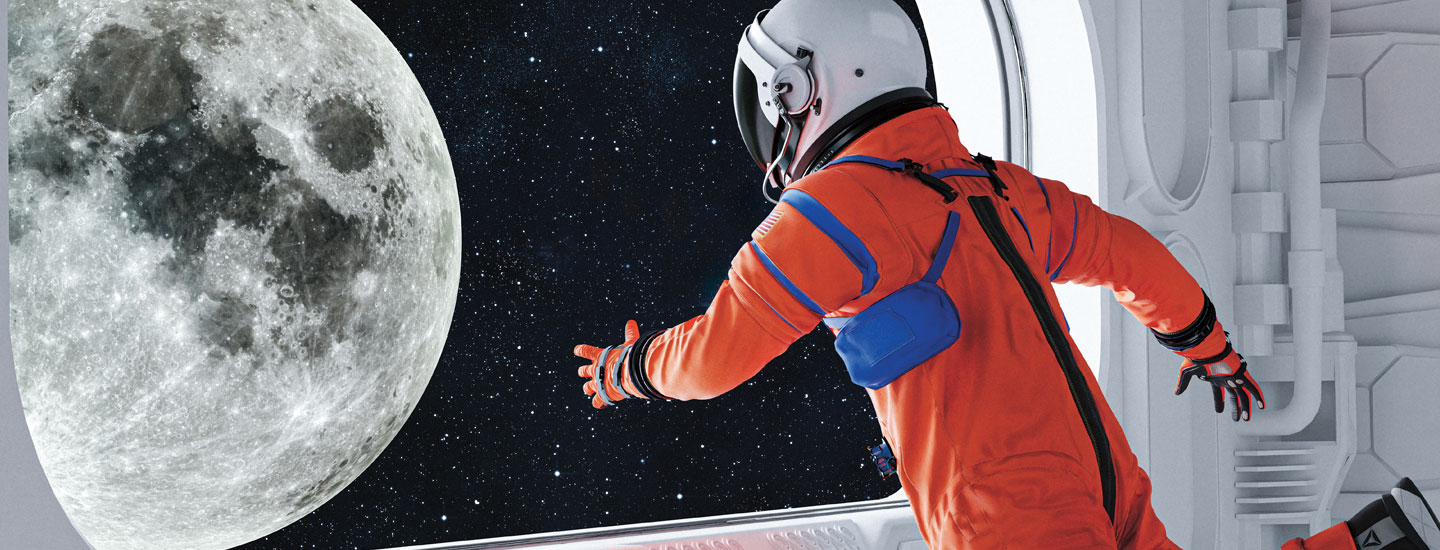
Illustration by Magictorch; 3d_molier International/Turbosquid (spacesuit)
STANDARDS
NCSS: Science, Technology, and Society
Common Core: W.4

U.S. NEWS
Shooting for the Moon
Four astronauts are set to go deeper into space than any humans have gone before. How will their trip get us closer to Mars?
Question: Why do the U.S. and other countries want to send people to the moon?
NASA/Kim Shiflett
Victor Glover
When Victor Glover was a kid, he was fascinated by the moon. He’d sit in his backyard at night, his head turned upward. “I never owned a telescope; I couldn’t afford one,” Glover recalls. “But I would stare at the moon and just all the different phases, watching it change.”
Glover will soon get a better view of the moon than he ever dreamed. As early as this February, he and three other astronauts are set to become the first humans in more than 50 years to fly around Earth’s closest neighbor.
The Artemis II crew will travel farther into space than humans have ever gone—up to 10,300 miles past the far side of the moon. And they will achieve more historic firsts—Glover will be the first Black astronaut to go on a lunar voyage. Christina Koch will be the first female astronaut to head to the moon. And Canadian astronaut Jeremy Hansen will be the first non-American to go.
NASA plans to land humans on the moon in 2027 and then to set up a lunar space station.
But the mission’s main goal isn’t to set records. Traveling in the Orion spacecraft, the Artemis II astronauts will be testing the vehicle as they go. Orion has already orbited the moon once, during the Artemis I mission in 2022, without anyone on board.
“Our job is to make sure that Orion is safe for humans to fly to and from the moon,” Glover explains. “At the end of the day, if we splash down successfully, that is the big mission objective.”
The Artemis program is a joint venture between the United States, private companies, and nations including Japan, Canada, and the United Arab Emirates. Together they want to return people to the moon’s surface. No human has set foot there since 1972. Then from the moon, the plan is to eventually send astronauts to Mars.
“We’ve got our eyes set farther, deeper into space,” says Lakiesha Hawkins, a top official at NASA, the U.S. space agency. “[We want to] show that we can establish a presence on Mars and further destinations.”
The Space Race
The U.S. is the only country that has put people on the moon. Starting in 1968, NASA sent 24 astronauts there (see “The Apollo Program” slideshow, below).
At the time, the U.S. was competing with the Soviet Union in the Cold War, a political power struggle that lasted from 1947 to 1991. The rivalry extended to space, where both nations raced to achieve milestones. With the Apollo program, the U.S. came out on top.
After that, NASA turned to robots to explore deep space. But officials say sending humans back to the moon will offer new insights. The Apollo missions explored only part of the moon. Scientists suspect that other regions, including the north and south poles, could contain important discoveries. For example, astronauts may be able to determine whether the poles hold water ice that could help humans live on the moon.
During the Flight
Robert Markowitz NASA-JSC
The Artemis II crew (clockwise from top left): Victor Glover, Jeremy Hansen, Christina Koch, and Reid Wiseman
Artemis II will orbit Earth twice. Then it will slingshot on a path to the moon, where the astronauts will get never-before-seen views of the lunar surface. Up to 60 percent of what they will see on the far side of the moon has not been seen by human eyes, scientists say.
During the journey, the crew will perform experiments to help scientists prepare for longer moon missions. One study will track their mental well-being while working, eating, and exercising in a small space. Their shared living area for the 10-day mission is 11 feet high and less than 17 feet across.
NASA also wants to see how flying so far into space affects the astronauts’ physical health, including hand-eye coordination and balance. To measure this, the crew will perform an obstacle course before takeoff and after landing. The astronauts will also collect saliva samples during the flight.
In addition, scientists want to look for possible effects of radiation. The area beyond the moon is less shielded from the potentially dangerous form of energy. NASA wants to figure out how to protect crews on longer missions who will be exposed to more radiation.
Alamy Stock Photo
Engineers work on the Orion spacecraft.
To Mars and Beyond
If this flight goes as planned, the next one—Artemis III—is set for mid-2027. Astronauts will land near the moon’s south pole and explore there for about a week. Then the U.S. and its allies plan to set up a space station called Gateway that will orbit the moon. Artemis IV astronauts will temporarily stay on Gateway. The station could one day support missions into deeper space.
Officials say the Artemis program isn’t just about exploration, however. China—a rival of the U.S.—also plans to send humans to the moon, by 2030. The U.S. wants to make sure American astronauts get there first so it can play a leading role in deciding how countries should interact in space.
That discussion has already started. Nearly 60 countries have signed the Artemis Accords. The U.S.-led pact confirms shared principles and guidelines to keep space friendly for the benefit of all. China has not signed it.
Glover, for one, is thinking about his role in that global cooperation as he prepares for his mission. “[As astronauts,] we have the privilege of representing all our countries,” he explains. “But when you leave the planet, you represent humanity.”
YOUR TURN
Make Your Case
Would you want to be an astronaut on the Artemis II mission? Why or why not? Write a paragraph explaining your answer, using evidence from the article and your own research to support your perspective.
Interactive Quiz for this article
Click the Google Classroom button below to share the Know the News quiz with your class.
Download .PDF