

Question: What was the Silk Road? Why was it important to ancient civilizations?
Question: What was the Silk Road? Why was it important to ancient civilizations?
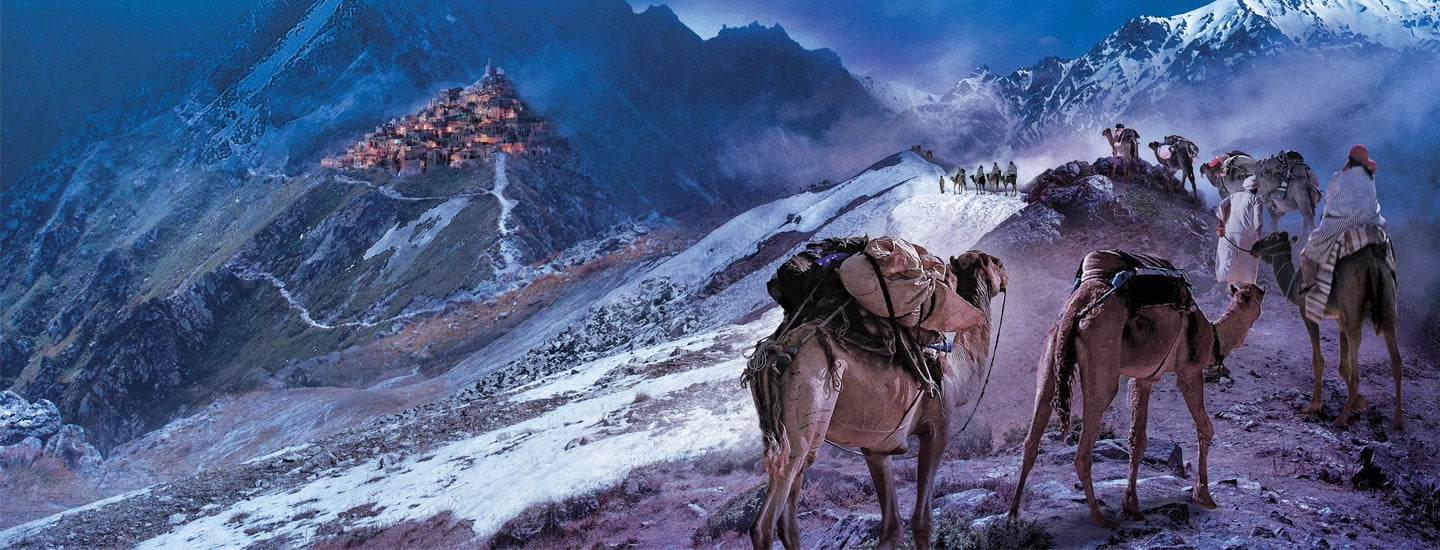
Illustration by Shane Rebenscheid
STANDARDS
NCSS: Time, Continuity, and Change • Global Connections
Common Core: R.7

GEOGRAPHY | WORLD HISTORY
Secrets of the Silk Road
How did two cities along the world’s most famous ancient trading route stay hidden for 1,000 years?
Question: What was the Silk Road? Why was it important to ancient civilizations?
Question: What was the Silk Road? Why was it important to ancient civilizations?
Jim McMahon/Mapman®
About 2,000 years ago, traders from East Asia made their way west carrying shimmering fabrics, magnificent jewels, and exotic spices. At the same time, merchants from Europe and the Middle East headed toward China with gold, silver, and other wonders of their own.
They traveled along a 4,000-mile-long route called the Silk Road. The ancient network of trading paths connected Africa, Asia, and Europe. Back then, it was one of the only ways people in those far-flung places could exchange goods with one another.
Modern historians know that Silk Road merchants endured dangerous conditions, including blizzards and blinding sandstorms. But a new discovery has revealed that some parts of the route were even more perilous than previously thought.
About 2,000 years ago, traders from East Asia made their way west. They were carrying shimmering fabrics, magnificent jewels, and exotic spices. At the same time, merchants from Europe and the Middle East headed toward China. They had gold, silver, and other wonders of their own.
They traveled along a 4,000-mile-long route called the Silk Road. The ancient network of trading paths connected Africa, Asia, and Europe. Back then, it was one of the only ways people in those faraway places could exchange goods with one another.
Modern historians know that Silk Road merchants faced dangerous conditions. For example, there were blizzards and blinding sandstorms. But a new discovery has revealed more about the route. It turns out that some parts were even riskier than previously thought.
The Silk Road was one of the only ways people in far-flung places could exchange goods.
Archaeologists recently uncovered two ancient Silk Road cities in the mountains of present-day Uzbekistan. The cities are called Tashbulak (TAHSH-boo-lahk) and Tugunbulak (TOO-gun-boo-lahk), and they are located about 7,000 feet above sea level. That’s thousands of feet higher than other known Silk Road stops, so reaching them would have required scaling steep mountains. Experts believe the cities in Central Asia were bustling urban areas that produced weapons and other goods.
The discovery indicates that the layout of the Silk Road was much larger and more complex than experts knew. And it suggests that ancient civilizations could—and did—build thriving communities in harsh, isolated landscapes.
Archaeologists recently uncovered two ancient Silk Road cities in the mountains of present-day Uzbekistan. The cities are called Tashbulak (TAHSH-boo-lahk) and Tugunbulak (TOO-gun-boo-lahk). They are located about 7,000 feet above sea level. That is thousands of feet higher than other known Silk Road stops. Reaching them would have required scaling steep mountains. Experts believe the cities in Central Asia were bustling urban areas that produced weapons and other goods.
The discovery indicates that the layout of the Silk Road was much larger and more complex than experts knew. It also suggests that ancient civilizations could build thriving communities in harsh, isolated landscapes. And they did.
Album/Alamy Stock Photo
Made in the 1300s, this illustration shows people traveling along the Silk Road.
Where East Met West
The Silk Road was developed around 130 B.C. in China. As traders ventured farther to sell their wares, the network grew. Eventually, it stretched from the Chinese city that is now called Xi’an (shee-ahn) in the east to the Mediterranean Sea in the west (see map, below).
Few merchants traveled the entire distance, however. Most moved back and forth between towns along the way, trading items such as paper and silk with people who carried the goods on the next leg of the journey.
Over time, trading posts and cities sprang up along the trails. Most were in lowland areas, which tend to have more comfortable climates and arable land for growing crops than places at higher elevations.
Merchants didn’t just exchange goods along the Silk Road. They also shared knowledge, cultures, and religions as well. Buddhism, for example—which originated in India—reached China and other Asian countries via merchants on the Silk Road. Christianity, Islam, and Hinduism also spread this way.
The Silk Road was developed around 130 B.C. in China. Traders ventured farther to sell their wares. So the network eventually grew. It started from the Chinese city that is now called Xi’an (shee-ahn) in the east. And it stretched to the Mediterranean Sea in the west (see map, below).
But few merchants traveled the entire distance. Most moved back and forth between towns along the way. They traded items such as paper and silk. They traded with people who carried the goods on the next leg of the journey.
Over time, trading posts and cities sprang up along the trails. Most were in lowland areas. Those tend to have more comfortable climates than places at higher elevations. They also have more arable land for growing crops.
Merchants did not just exchange goods along the Silk Road. They also shared knowledge, cultures, and religions as well. For example, Buddhism originated in India. But it reached China and other Asian countries via merchants on the Silk Road. Christianity, Islam, and Hinduism also spread this way.
Ryan Bell
These raised areas may be the walls of the lost city of Tugunbulak, buried under the earth.
Learning With Lasers
Researchers think the newly discovered cities were major stops on the trading route. Archaeologists found Tashbulak in 2011 while out on a mountain hike in southeastern Uzbekistan near the known Silk Road path. As they began excavating the site a few years later, they found evidence of an even larger city, Tugunbulak, about 3 miles away. Both sites contained pieces of pottery that dated to around 750 A.D.
However, the steep, rugged terrain and frigid winters made it difficult for scientists to investigate the area further in person. So in 2022, they turned to a type of laser technology called lidar. That stands for light detection and ranging. Researchers sent a low-flying drone equipped with lidar to the site. The drone fired millions of laser pulses into the ground. The data from the lasers helped them build a map of what’s beneath the surface.
As the map came together, the researchers couldn’t believe their eyes. Tugunbulak is nearly 300 acres, making it one of the largest ancient cities in the region at the time. Tashbulak is about 30 acres.
Researchers think the newly discovered cities were major stops on the trading route. Archaeologists found Tashbulak in 2011. They were out on a mountain hike in southeastern Uzbekistan. They were near the known Silk Road path. They began excavating the site a few years later. And they found evidence of an even larger city, Tugunbulak. It was about 3 miles away. Both sites contained pieces of pottery that dated to around 750 A.D.
But the terrain is steep and rugged there. And winters are frigid. That made it difficult for scientists to investigate the area further in person. So in 2022, they turned to a type of laser technology called lidar. That stands for light detection and ranging. Researchers sent a low-flying drone equipped with lidar to the site. The drone fired millions of laser pulses into the ground. The data from the lasers helped them build a map of what is beneath the surface.
The map came together. And the researchers could not believe their eyes. Tugunbulak is nearly 300 acres. That made it one of the largest ancient cities in the region at the time. Tashbulak is about 30 acres.
The discovery of these ancient cities is changing what we know about central Asia.
Experts think the cities were established sometime around the 6th century. The sites contain the remains of complex stone buildings, plazas, and roads. The laser scans also revealed massive fortresses at Tugunbulak and hundreds of other structures. One part of the city may have housed up to 5,000 people.
What’s more, both cities had sites for metal production. Because the surrounding mountains are rich in iron ore, researchers think the cities were major producers of steel objects, including weapons. This may have been how the communities supported themselves in such a harsh environment, experts say.
“These new sites . . . show that people were adapting and working out how to trade with each other,” says Peter Frankopan, a history professor at the University of Oxford in the United Kingdom who specializes in Central Asia.
Experts think the cities were established sometime around the 6th century. The sites contain the remains of complex stone buildings, plazas, and roads. The laser scans also revealed massive fortresses at Tugunbulak and hundreds of other structures. One part of the city may have housed up to 5,000 people.
In addition, both cities had sites for metal production. The surrounding mountains are rich in iron ore. So researchers think the cities were major producers of steel objects. That included weapons. This may have been how the communities supported themselves in such a harsh environment, experts say.
“These new sites . . . show that people were adapting and working out how to trade with each other,” says Peter Frankopan. He is a history professor at the University of Oxford in the United Kingdom. He specializes in Central Asia.
More to Discover
Researchers estimate that Tashbulak and Tugunbulak fell sometime around the 11th century, possibly because of political disputes. Other parts of the Silk Road remained in use for several more centuries. But eventually, more and more merchants started traveling by sea, which proved to be a safer, faster, and cheaper way to trade goods. By the 15th century, the Silk Road had largely been replaced by other modes of travel.
Hundreds of years later, the discovery of these two cities has sparked renewed interest in the Silk Road. Archaeologists are convinced there are more high-elevation cities waiting to be found.
But for now, there’s still plenty to learn about Tashbulak and Tugunbulak. Experts have been slowly working to unearth the cities. They hope to learn more about how the populations changed over time. That knowledge will likely alter our modern understanding of the region’s ancient people, says Farhod Maksudov. He is one of the archaeologists who helped make the discovery.
“The history of Central Asia,” Maksudov told reporters, “is now changing with this finding.”
Researchers estimate that Tashbulak and Tugunbulak fell sometime around the 11th century. It is possible that they fell because of political disputes. Other parts of the Silk Road remained in use for several more centuries. But eventually, more and more merchants started traveling by sea. That proved to be a safer, faster, and cheaper way to trade goods. By the 15th century, the Silk Road had largely been replaced by other modes of travel.
Hundreds of years later, the discovery of these two cities has sparked renewed interest in the Silk Road. Archaeologists are convinced there are more high-elevation cities waiting to be found.
But for now, there is still plenty to learn about Tashbulak and Tugunbulak. Experts have been slowly working to unearth the cities. They hope to learn more about how the populations changed over time. That knowledge will likely alter our modern understanding of the region’s ancient people, says Farhod Maksudov. He is one of the archaeologists who helped make the discovery.
“The history of Central Asia,” Maksudov told reporters, “is now changing with this finding.”
Interactive Quiz for this article
Click the Google Classroom button below to share the Know the News quiz with your class.
Download .PDF